A young American woman, 22 years old is training for her first marathon in Italy. She is using a plan which is very similar to what both my husband and I used to run our first marathons. You can find the 16 week plan at Rookie Marathon Training Plan
My husband started running in his early twenties and ran his first marathon a few years later, using a Runner’s World, Three-Months to a Marathon plan. I was in my mid-twenties and had been running a few weeks, when I decided to train for a marathon using the same plan which Runner’s World recycles yearly. So I feel some nostalgia in reading about this woman’s ambition to run a marathon when she returns to the U.S. She is calling it the SkinnyItaly Project. Go, go, young one, you CAN do it. YES, you can.
I’m going to be MADE. Into a Marathoner. My coach will be my own stubbornness and muscle tension from my daily lifestyle in Italy. Running a marathon has been on my BUCKET LIST (aka life goals), along with building orphanages in Uganda.
You can check out the full story of the SkinnyItaly project HERE.
I’m inspired by the marvelous energy and enthusiasm of the young. It is easy as one ages to view youth as a phase we passed through and thought better of it. I like to think that we can distill the essence of youth and reinvent ourselves as youth-full in spirit as we age, or at the very least, appreciate it vicariously. Although, like George Sheehan I’ve often thought that running has been, and still is my fountain of youth. Vigour is definitely a good foundation for optimism.
Dostoevsky said that “The second half of a man’s life is made up of nothing but the habits he has acquired during the first half.” However sobering this gloomy outlook may be, know truly that it is never too late to start exercising regularly, or too early.
Since football is in the air, I thought to recall the bookInstant Replywhich I read when I was 13. I have never been a football fan and just found out two minutes ago that that the Green Bay Packers are contesting the Super Bowl this year when my husband called me upstairs to view the half-time show. I was however an avid baseball and hockey fan and loved (and still love) to read biographies and autobiographies.
Around this time I was a weekly volunteer at the local library and I began to read my way through the biography section, which included, Fire Wagon Hockey:The Story of the Montreal Canadiens, biographies of Sandy Koufax, Roger Crozier and Bobby Hull, and Ball Foura controversial book which came to be “considered one of the most important sports books ever written.” according to Wikipedia. Other bios I remember reading then were of Ghandi, Martin Luther, Madame Curie, Dame Margot Fonteyn, Louis Pasteur & Joan of Arc. This reading predilection fits with my Meyers-Briggs, people-person personality type.
Here is a description of Instant Replay from Amazon.com
“In 1967, when Jerry Kramer was a thirty-one-year-old Green Bay Packers offensive lineman, in his tenth year with the team, he decided to keep a diary of the season. “Perhaps, by setting down my daily thoughts and observations,” he wrote, “I’ll be able to understand precisely what it is that draws me back to professional football.” Little did Kramer know that the 1967 season would be one of the most remarkable in the history of pro football, culminating with the legendary championship game against Dallas now known as the “Ice Bowl,” in which Kramer would play a central role . Washington Post’s Jonathan Yardley, calls it “to this day, the best inside account of pro football, indeed the best book ever written about that sport and that league.”
This groundbreaking look inside the world of professional football is one of the first books ever to take readers into the locker room and reveal the inner workings of a professional sports franchise. He also offers a rare and insightful view of the team’s storied leader, Coach Vince Lombardi.
Bringing the book back into print for the first time in more than a decade, this new edition of Instant Replay retains the classic look of the original and includes a foreword by Jonathan Yardley and additional rarely seen photos from the celebrated “Lombardi era.”
Gee, this sounds compelling (well for a sports book at least) maybe I should reread and perhaps this is a good Valentine’s gift for a football fan? As for runner biographies, I would recommend Running with the Legends: Training and Racing Insights from 21 Great Runners by Michael Sandrock, the book is as described and will not disappoint. Complete with sample training schedules, the most important insight gained will be that there is no formula. This panorama of athletic experience will convince you that, once you have a solid understanding of the basic physiology of training, trusting your own instincts, is what it is all about. Your own way, also involves the self-knowledge to determine psychological fit with workout types. More generally applied, self-knowledge will also enable you to determine what sport or fitness activity suits your physiological and psychological profile.
As for my love of biographies, these days I’m more likely to be reading about writers and political figures although I did enjoy Lance Armstrong’s, Every Second Counts a few years ago. At the moment I’m reading a short biography of Lord Byron written by Edna O’Brien. More out of interest in the biographer, than the subject. Edna O’Brien has written an excellent biography of James Joyce which both my husband and I read after a trip to Ireland.
My husband and I were discussing what stages of weight training each of us is in. I am in the Maximum Transition (MT) phase and he is in the Maximum Strength (MS) phase. He asked a few questions about how many repetitions he should be doing and how many weeks. My answer; um, you could check my blog. Said he, “So now you won’t talk to me, I have to talk to the blog?”. I chortled but I think he was hoping for some sympathy.
There is a certain convenience in having some of my thoughts about training collected and recorded. With 30 years of running experience, I get asked the same questions with some regularity.
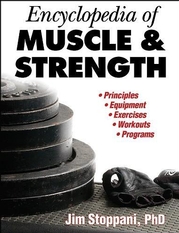
A recent question in response to my post on weight training was a recommendation for a current book on the subject that is easily available. I asked my weight training consultant, champion triathlete Beverley Coburnof Active Age Fitnessfor her thoughts.
Here they are:
“Really like the book, Encyclopedia of Muscle & Strength by Jim Stoppani (Human Kinetics). This book has everything in it for building programs for beginners up to bodybuilders. I especially like the details. Stoppani describes the muscles and exercises for each muscle group i.e. shoulders with isolation and compound exercises for the front, rear and medial deltoids – great for developing muscle balance. Another book that has great pics is Strength Training Anatomy by Frederic Delavier.
I’ve seen Strength Training Anatomy in bookstores for around $25. Encyclopedia of Muscle and Strength, I purchased on-line through Human Kinetics – possibly in bookstores too (somewhere around $25-$35).”
Would someone you love, like to receive this as a Valentine’s gift?
February 2011 it turns out, will be a very social month for us, more so than the holiday season. With an outing tonight and tomorrow, I decided to do a solo long run this morning to avoid a weekend long run. For a moment, I considered doing my 14 miler on the treadmill, discouraged by the overcast sky but thought better of it.
Four miles into the run, I took part in an email exchange around a confusion about whether the racing, mentioned a few days ago, was happening today. I suppose having a BlackBerry is a bit of consolation, a kind of companion when you are slogging it out in the winter with no company. There are those days when it takes a lot of positive self-talk to get out there and train so if the promise of being able to check email every few miles makes it a bit easier, so be it.
I enjoyed the section in Murakami’s What I Talk About When I Talk About Running where he describes his interview with Toshiko Seko one of Japan’s great marathon runners. Murakami asks Seko if there are days when he doesn’t feel like running. Seko looked at him with a you-must-be-joking expression and answers that of course, there are those days, every day in fact! If one considers the difficulty of his training routine, it makes perfect sense. As we say in the business, the man is a “machine”.
In truth, for those who run every day, however humble our goals, we rely on all manner of mental gymnastics to get out the door. Discipline is a lot about becoming highly adept at finding the many reasons, why, why, why when so much of the mind and body says, no, no, no. Anyhow, today was such a day but as usual I reminded myself of how great I feel after a long run and how much I like the results of being highly fit and running fast times. Additionally, I remind myself of how much I dislike the results of less activity. When I started running, I was very motivated by the benefit of stress release and used to visualize that I was leaving stress behind like a trail of soot on the road.
My route in a nutshell was west to High Park with a short loop there, then back east through the CNE grounds, past Ontario Place and over to Harbourfront, with a northwest beeline for home.
View From Ontario Place
There was a very pretty pink hue hovering on the horizon which made for a pleasant sight while running past Ontario Place. East of there is the Tip Top Tailor building. I’ve run by the Tip Top Tailor building, now converted into lofts for decades, and often wondered about the interior. Today I’ll get the inside story, as that is where we are headed this evening.
I made a pit stop at Harbourfront Center and took a moment to enjoy a photography exhibit. A photo by Jesse Boleswhich is part of an exhibit called Piles caught my eye. The aesthetic is similar to art that I enjoyed in my younger days. And then I hit the road again, face to face with a very strong west wind. This is the first year that I’ve had a vented face protector and it is a big improvement over the muffler style face warmers which can get iced up in super-cold temperatures.
Photograph by Jesse Boles
My final stop was the dry cleaners, from there jogging the final stretch home, cleaning in hand. Finishing felt so good that I cheered out loud for myself!
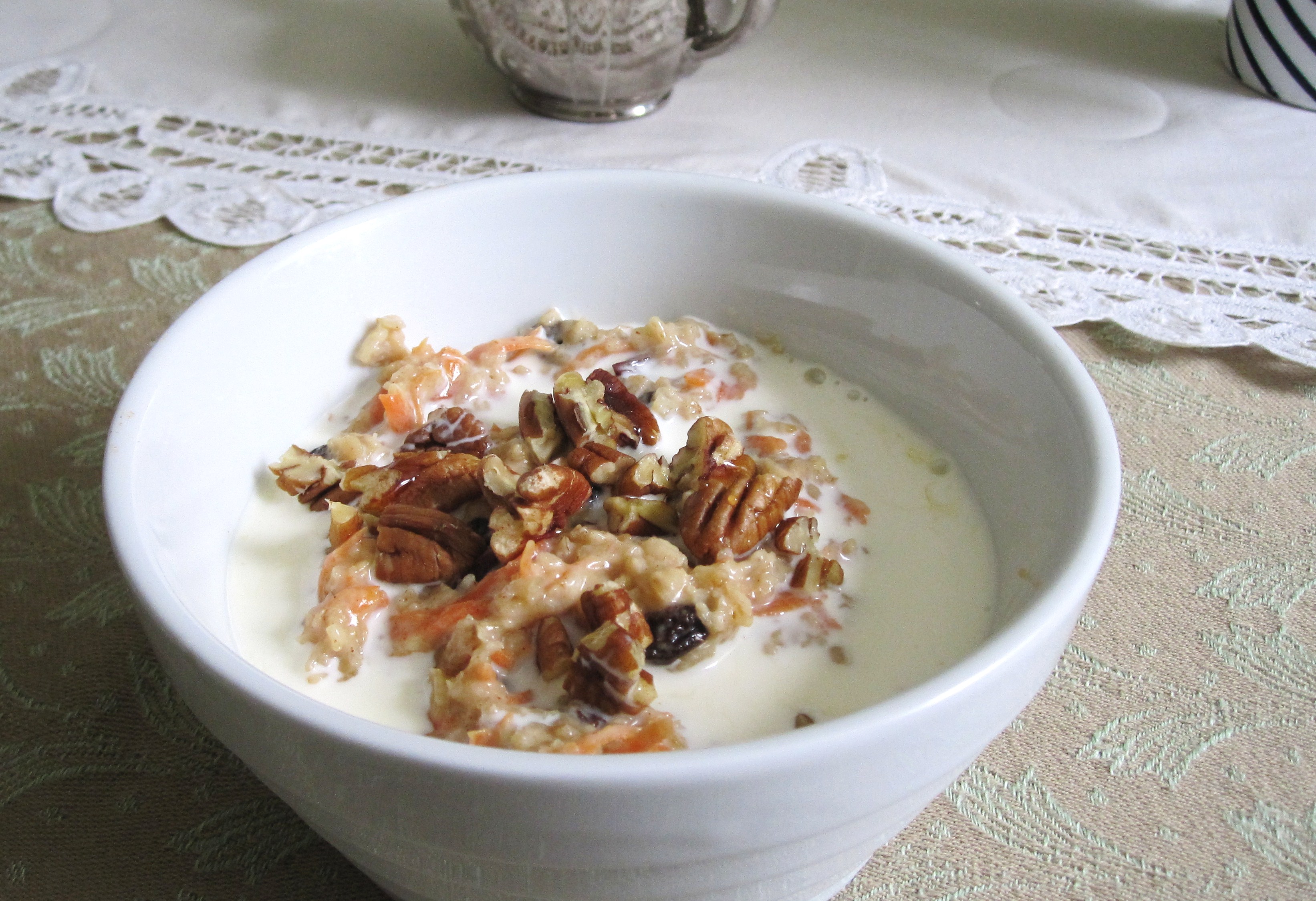
As with the camping experience, food tastes better after a long run, so I eagerly dove right into breakfast by making my quickie version of Carrot Cake Oatmeal. If you haven’t tried it yet, you really must. It is super-fine stuff.
Breakfast of Champions
Recipe: In large microwavable bowl combine 1 cup grated carrots, 1 cup milk, 1/2 cup oats (not quick cooking oats), 1/4 teaspoon vanilla, a dash of cinnamon, raisins (optional), dried cranberries (optional) and cook on high for 5 minutes. Stir. Add chopped pecans, maple syrup and milk or cream. Make sure the bowl you cook the oatmeal in is at least twice the volume of the ingredients as it will boil and bubble vigorously.
YOU MUST TRY THIS!
There was some leftover whipping cream in the fridge so I indulged, and used that instead of milk. This is my third post about Carrot Cake Oatmeal, and I urge you to give it a try. It’s a real winner and will add excitement to your breakfast table this winter. And how virtuous one feels starting the day with a cup of grated carrot in your cereal, especially after a hardy workout!
“Your net worth to the world is usually determined by what remains after your bad habits are subtracted from your good ones.” Benjamin Franklin
Having been born and raised in Montreal, childhood memories involve what seemed like mini-mountain ranges lining the streets providing great climbing opportunities for the agile and fleet of foot. I recall going to a school in a neighbouring suburb almost two miles away however, there was a short cut through the woods that was just a mile and I would sometimes hike home, even when I had to trudge through thigh-high snow. I had a propensity then to push myself physically, a little further, a little faster.
From the age of 12 to 16 I playedRingette, mainly on outdoor rinks and it did get cold. I don’t remember any game cancellations due to cold, rather the opposite, when the temperature was too high to produce a reasonable ice surface. After a couple of years, neighbouring municipalities started Ringette leagues on indoor rinks and my best ringette buddy and I joined another league. The fun came when we ended up on the all-star teams for both towns. We chose to play for the weaker team although I had a ball because I got to play forward, rather than my usual defence position.
In those days there was no such thing as a girls hockey league, Ringette was the adapted ice sport, suitable for girls. The only girls who wore hockey skates then were a couple of girls who had serious hockey playing dads, the daughter of professional hockey player, Fleming McKellfor instance. The rest of us wore figure skates and we filed the toe picks off.
I started out as a goalie but did not particularly shine or enjoy the position. My brothers used to chant this, “Lynn, Lynn she’s so thin, she always lets the ring go in”. I was quite a fast skater and because of this my coaches always put me on defence because I had a knack for being in the right place, and could usually put on a burst of speed to get in the way of an opponent. In ringette at that time there was a weird rule that defence players could not go into the offensive zone. Very dull, to say the least. I hope they’ve changed that rule. Did you know that Canada has the highest number of ringette players, over 50,000!
Look ma, no gloves!
I enjoyed today’s marvelous sun. I left the house in full winter gear, and ended up feeling quite overdressed. At least one can exercise some temperature control by removing a layer on a day like this. Which reminds me of when my son was in grade school and I would run by the school yard to make sure he was dressed properly on the really cold days, finding him at times playing in the schoolyard, having ditched his jacket.
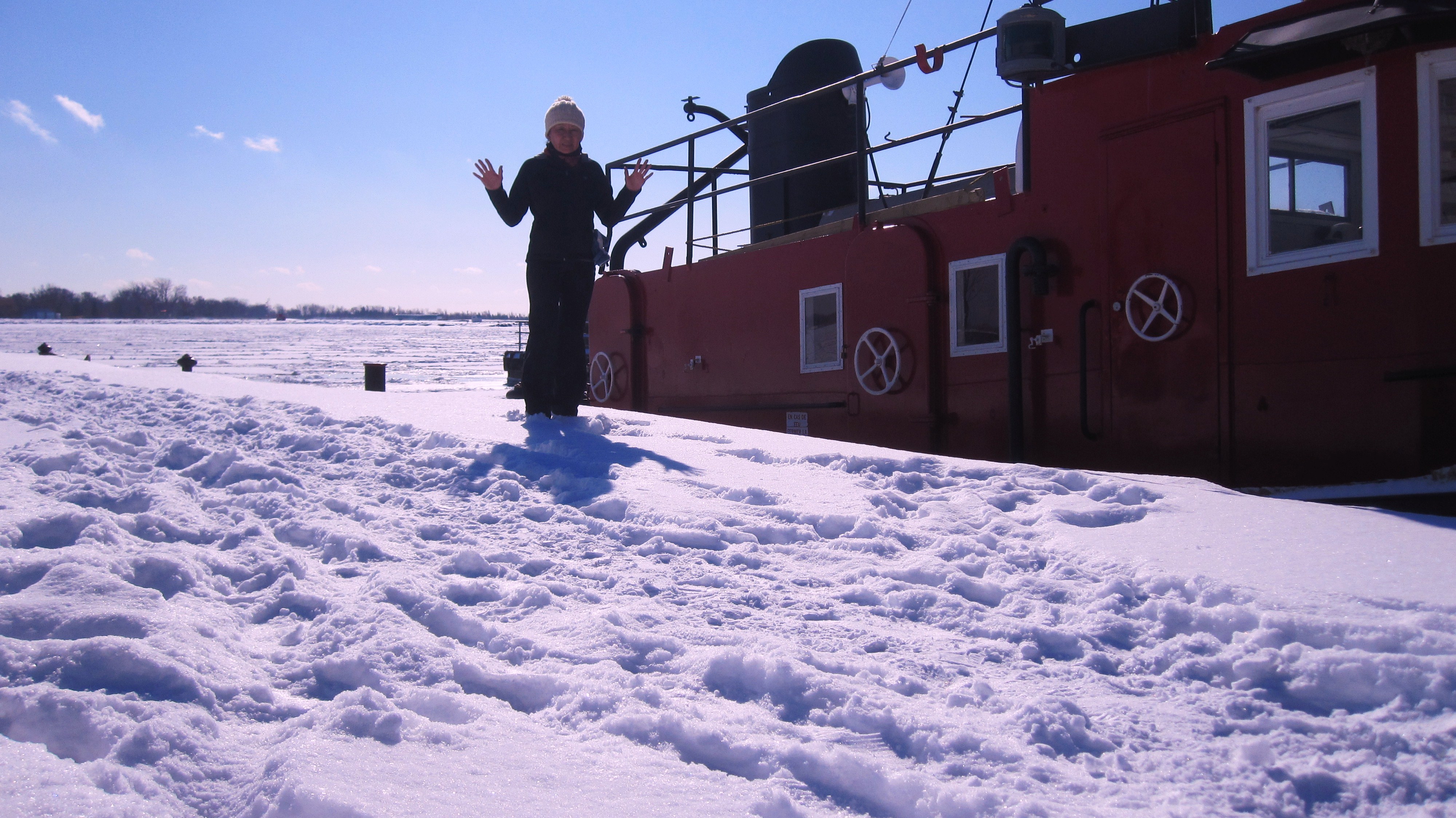
I dread those stifling hot, muggy days of summer. Down by the lake, sun shining, winter white seems . . . quite alright.
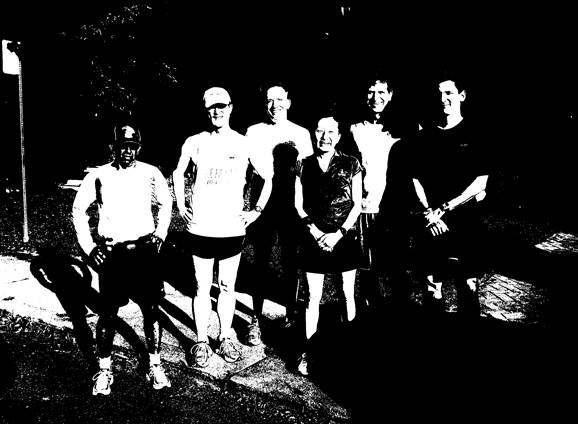
Something funny happened on our Saturday run. Four of us decided that we may take part in an informal race. To those unfamiliar with our running group ethic, this may not seem strange or funny however one characteristic of this running group is that I am the only one who races these days and we don’t talk about running a whole lot.
The idea started when I joined forces with “D” to convince “R” that as the youngster in the group, a bit of fast running might be good for his character. “R” was reticent and said he would agree, only if all five of us were to race. “D” and I, knowing full well that convincing “B” who has recently come down with a case of knee-moania was a non-starter, suggested this was a bad faith approach. He then offered that if “B” agreed to watch the race, he would do it. A funny idea that. Again, “D” and I persisted and finally got “R” to agree that if “J” was willing, he was in. This discussion took place as the three of us were headed towards “J”s house.
Smart Men & One Fast Woman
Barely passed the hellos, we quizzed “J” who immediately said, “Sure, I guess this is my chance to be humiliated.” Anyhow, sometime this winter at a indoor track, at an informal race, that has been going on every Friday for over three decades, four of us may take the plunge and race two miles alongside (or against) each other. Stay tuned.
I am curious to see what “B” who was out of town on Saturday, thinks of this. Given the learned background of my running mates, perhaps I will be privy to a discussion of whether Plato or Aristotle would condone or condemn our planned course of action. As for the bets, I’m told they are on ME — but I’m not as fit as past years, and I’m not sure if I would put my money on an aging filly over a two mile sprint.
Snow, snow, snow . . . will this storm materialize as predicted? I thought this might be a good time to list the different indoor venues where I have done long runs when poor conditions prevailed. In days of yore, treadmills were not available at fitness facilities, so most runners slogged it out on the roads. I’ve always been finicky about poor footing due to chronic ankle troubles stemming from having severely sprained my ankle at age 13 on a trampoline. Consequently, I’m usually the first to head indoors to find relief from slipping and sliding outdoors.
I once ran 18 miles on this track, a total of 4955.5 laps in the early-eighties. David Suzuki used to be a regular on this teeny track.
Former Central YMCA on College Street
The West End YMCA
15.5 laps to the mile.
I ran a full marathon, 26.2 miles here in the mid-eighties, a total of 380 laps.
Hart House Track at the University of Toronto
About 11.3 laps to the mile
I’ve run 12 miles on this track. Although it is bigger than the old Central YMCA track the banking is horrible and I would not recommend doing a long run here.
The Athletic Centre at the University of Toronto
8 laps to the mile
About 6-7 years ago I ran 23 miles on the outside track and ran by time rather than counting laps. Who says we don’t get smarter with age.
The York University Track
8 laps to the mile
I’ve run a number of track races on the indoor track, which has excellent banking and run on the outer warm-up track before and after workouts or races. I’ve never done a long run there but I imagine it would be fairly entertaining with all the high-performance activity on the inside track. My husband and I used to see the infamous Ben Johnson work out on the sprint lanes.
The Eaton Centre
One New Years Day in the eighties I ran a few miles here, having started outside during a snowstorm, I ducked inside and logged some miles in the mall.
Treadmill
The most miles I’ve run on a treadmill is 18 miles which I did a few years back.
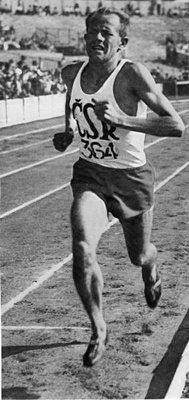
If you think this sounds crazy consider this, legendary marathoner Emil Zapotek’ssolution to training in harsh weather. Zapotek would fill his bathtub with water and then his laundry and run in place for hours. Zapotek is remembered for winning triple gold in the 5K, 10K and marathon at the 1952 Helsinki Olympics.






 Mind, Motion & Matter