The wickedly cold Edmonton temperature during our visit last Sunday of -26C has been displaced by +5C. What is going on? And here in Toronto, the capital of not-so-cold-but-damp-cold it is -17C. Wrong place at the wrong time.
Total mileage this week was 50 miles, with four indoor and three outdoor runs. Five or six years ago during a particularly cold January, I ran 31 days with only three outdoor runs. So it could be worse. Thinking of worse I’m reminded of the power failure two winters ago. Funnily enough, our gas furnace was so old (since replaced) that it was able to continue to produce heat and with gas stove and oven, the hardship was not severe. I’m also remembering that a few years ago, I ran the Robbie Burns 8Kin Burlington in a time of 34:58 in -20C temperatures on packed ice and snow. Needless to say, I felt that were conditions better, I might have run faster.
The Communal Mule
We have stayed close to home these past chilly days. Once again, we considered a movie outing and once again, we chose to hunker down on the homestead our only outing, to shop with a coffee break enroute. We tried a new coffee barThe Communal Muleon Dundas west and enjoyed as my husband calls it, “Being tourists in the land of youth.” as inevitably we seem to be the oldest people about in our travels to nouveau espresso bars. I had an excellent shortbread with white chocolate chip cookie and my husband enjoyed his latte.
As for me, I’ve become a bit stuck on Stumptown coffee. Give me Stumptown coffee, Stumptown I say! I’m a believer. There is only one place in Toronto (2 in Canada total) where Stumptown coffee is available, LIT Espresso Bar. We have only been to the College street locations.
Stumptown Coffee at LIT Espresso Bar
Quiet days mean more time to read and I finished The Sea Ladyby Margaret Drabble. The “elegiac” writing and pace of the first 250 pages led to a disappointing finale, complete with a surprise ending, where everything came together, not with elegance but more like a season-ending episode of Desperate Housewives. My very humble opinion for what it is worth, although still recommended as a pretty good read.
The final pages of The Sea Lady contain these words from Scotland’s favourite son, whose birthday is celebrated on January 25th. And — to my husband, I’ll dedicate these lines from Robbie Burns and repeat that NO, the final quote of yesterdays post was in no way related to your plan to watch six hours of football this weekend.
I’ve added a link to my blog to a website honouring the late George Sheehan, the voice of the first running boom that began in the late-seventies. He wrote regularly for Runner’s World and captured the imagination of the many, who took up running during this first wave of enthusiasm for long distance running. His writing was a blend of pithy running one-liners like, “Don’t be concerned if running or exercise will add years to your life, be concerned with adding life to your years.” woven with an unrelenting stream of philosophical quotes to illustrate the best of the running experience. A William James quote “The strenuous life tastes better.” was one of his favourites.
A favourite quote of mine came out of his constant reminder to listen to your body because, “We are an experiment of one.” Some have said that the first running boom was driven by type “A” overachievers, a mischaracterization, when one considers George Sheehan’s place as the most influential voice of that first boom. His premiere work, Running and Being was a New York Times bestseller.
Find out more about George Sheehan by visiting www.georgesheehan.com a website created by his children to preserve the legacy of his contribution to the sport.
From the moment you become a spectator, everything is downhill.
George Sheehan
Books by George Sheehan
* Dr. Sheehan on Running (1975)
* Dr. George Sheehan’s Medical Advice for Runners (1978)
* Running & Being: The Total Experience (1978)
*This Running Life (1980)
* How to Feel Great Twenty Four Hours a Day (1983)
* Dr. Sheehan on Fitness (1983)
* Personal Best: The Foremost Philosopher of Fitness Shares Techniques and Tactics for Success and Self-Liberation (1989)
* George Sheehan on Running to Win : How to Achieve the Physical, Mental & Spiritual Victories of Running (1992)
* Going the Distance: One Man’s Journey to the End of His Life (1996)
If you have been following my blog, you’ll know that most of the time, I don’t think about running, when I am running. I’ve forwarded the proposition that the more reasons you have to run, and the more that you have to think about while running, the easier it is to stick to running. Does it follow then that since I run A LOT, a lot of what I think about is not about running? Possibly.
Some of those thoughts and activities that occupy me or take place on the run include listening to music and audio books, watching television, list-making, photography, shopping, meal-planning and recently, I’ve become adept at checking my Blackberry while running on a treadmill.
The Pain Gain
However faster running, involving effort, discomfort and pain requires that thoughts be focused on running and it is helpful to develop positive mental strategies to deal with these more challenging physical sensations. At the moment, faster running is about 40 minutes out of the roughly 6-7 hours a week I run. A big part of what motivates me to push past the discomfort and pain is the knowledge of the health benefits of intense running. When you exercise at an intensity over the lactate threshold your body produces Exercise-Induced Growth Hormone Response (EIGR) the effect of which is double the benefit of aerobic exercise.
While running hard, I visually imagine EIGR secretions flowing through my body and soothing my joints. I also think of my heart, pumping vigorously sending blood in strong gushes throughout my circulatory system, massaging and cleansing my arteries. While these images may not be sound biology, you get the picture, it is all about the importance of positive images.
Knee Joint Facsimile
My husband has been having knee trouble for nearly two years. As a joke, I gave him a key chain with a replica of a knee joint. As time passes, I’m thinking that this rattling, fragile looking knee joint may not inspire confidence in recovery and only lends fuel to the argument that the knee joint is poorly designed and engineered. Not the best mindset for visual images of healing and health.
The simple practice described in this quote by Jean Houston strikes me as wise, at the gut level.
“Try to spend a few moments each day holding a picture of your body and your mind in a state of splendid health.”
What happens when you drop into Starbuck’s and discover that you’ve forgotten the book you are dying to finish? Happily for me, you run into an old friend of over 25 years with whom you are long overdue to catch up with. With me, the catching up process usually involves a “Still running?” inquiry and in this instance more than two hours of chatting.
Part of my friend’s news was that recently a car drove into the front of her restaurant at 4:30 a.m. causing a fair bit of damage which included squashing her bike, left parked overnight for one of three times in 11 years. Monica is the owner of Saving Grace Cafe on Dundas West, as in this review of Toronto restaurant brunch offerings by NOW Magazine.
Saving Grace
907 Dundas W, at Bellwoods, 416-703-7368. Monica Miller’s intentionally anonymous café is always bedlam on weekends. Regulars know to disregard the printed menu and go for the chalkboard specials. Best: devilishly textured corn cakes accompanied by chili-fired mango chutney and greens dressed with sun-dried tomato vinaigrette; waffle du jour with real maple syrup, or very plain scrambled eggs with pumpernickel toast and oven-roasted home fries; French toast with caramelized bananas in maple syrup. Open Saturday and Sunday 10 am to 3 pm. Licensed. Access: one step at door, washrooms upstairs. Rating: NNNN$$
"Photos of what happened to the front of my restaurant!"
I told her about the Carrot Cake Oatmealrecipe I had blogged about recently and we had a lively discussion of the culinary possibilities of oatmeal. She may test this recipe on her staff as a step towards adding it to her famous brunch menu.
Committed commuter cyclist and chef with her new wheels.
Upon leaving Starbucks, she showed me her replacement bike. There was a time when I cycled everywhere, all but 6-8 weeks of the year, but Monica has outlasted me in this pursuit by nearly two decades.
On the topic of chance meetings and food; What happens when you forget your key and need a place to hang out, to await rescue? Across from Starbuck’s is a new restaurant Hadley’s, where I dined in this instance, waiting for my husband to get home from work to let me in. I sat at the counter and shortly after an old friend, the phys. ed. teacher from my son’s elementary school, sat down beside me.
Portrait of a Great Phys. Ed. Teacher
She told me that has seen me regularly, running in the neighbourhood. We got to know each other during the years when I coached the school cross-country running team and assisted with the track and field team. She had just come from a school basketball game and modeled the latest version of the school t-shirt. She was a star basketball player and assistant coach with the University of Toronto Blues and was once a member of the national basketball team. It was good to hear that she is doing some teaching at OISE as she is a wonderful teacher and fabulous role model.
She urged me to have a taste of her appetizer, whitefish on green pea pancakes, an improbable combination which I would never thought of ordering. They were sensational!
Hadley's Whitefish on Green Pea Pancakes
I mentioned the green pea pancakes to Monica and she has such a recipe, which I hope to try. In case you are thinking about checking out Saving Grace, I think they close annually, in February, so call first to confirm. Bon appetit!
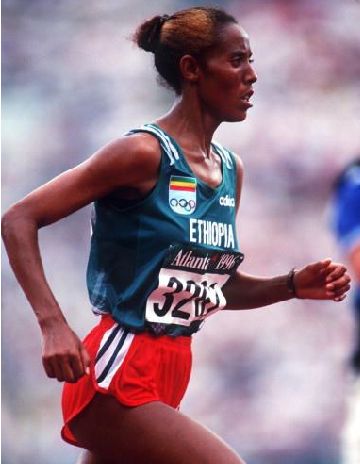
Today I lunched with a friend who is helping my husband and I organize a gala for a sponsorship program for AIDS-HIV orphans in Ethiopia. The program is supported mainly by volunteers, here in Canada is run by People to People Aid Organization, Canada Inc. . Thus I thought it would be timely to profile one of Ethiopia’s finest runners, Fatuma Roba who was the mother of five children when she won the Olympic gold medal.
Born in 1973 and raised in the village of Cokeji in Ethiopia’s mountainous southern region—also home to internationally known 10K champion Derartu Tulu—Roba was one of seven children born to a farming couple who raised and herded cattle. Like most children growing up in rural Africa, if she wanted to go somewhere, the quickest way to get there was to run. The daily run to and from her school—much of it going up and down hills—trained the young Roba in the art of sprinting. As a child her hero was 1960 and 1964 Olympic marathon champion Abebe Bikila, a fellow Ethiopian. After completing school, the five-foot-five-inch Roba decided to train to become a police officer after her performance at a national cross-country championship caught the attention of members of the Adis Ababa prison police athletic team.
Fatuma Roba, Fluid Grace
Roba first gained an international profile in 1990 when at age 18 she placed fourth in the 3,000 meter and 10K competition during the African Championships. Three years later she decided to attempt the 26.2-mile marathon distance in her home town of Addis Ababa, and had reached a personal best time of 2 hours 35 minutes 25 seconds by 1995. Roba continued to reduce her marathon time throughout the spring of 1996, helped along by the coaching of Yilma Berta. To train to excel at the 26.2-mile marathon distance, the 22-year-old Roba logged an average of 125 miles a week, most of it at high altitude, thereby forcing her body to use its resources of oxygen efficiently. She ran and won two marathons early in 1996, the first in January at Marakech and the second in Rome, Italy, two months later.
When Roba joined the field of the 1996 Olympic women’s marathon in Atlanta, Georgia, in July of 1996, she was ranked only 29th among the elite women athletes assembled there. Surprising almost all onlookers of that years’ Summer Games, she managed consistent five-minute miles, gained the lead by mile 13, and left behind Japanese runner Yuko Arimori, who had won the silver at the 1992 Summer Olympics in Barcelona, Spain. At mile 19 timers clocked her race pace at 5:21; relaxed and alert, Roba waved as she passed, the crowds cheering on the first woman in the pack. She went on to cross the line in 2:26:05, her lead a remarkable two minutes. “This is not only a special thing for me but also for my country and all African women,” Roba was quoted as commenting by Amanda Mays in the Philadelphia Inquirer. “The Ethiopian women are coming up in the marathon. This was the breakthrough and now we are ready to challenge the others.”
Roba’s success in Atlanta was balanced by an equally notable performance in 1997 at the 101st Boston Marathon. She gained and held an easy lead by mile 20 to win in 2:26:23. The first African woman ever to win the historic Boston race, Roba bested an elite field that included defending champion Uta Pippig, Japan’s Junko Asari, and South African runners Colleen de Reuck and Elana Meyer. “She ran with the same smooth stride and placid, dispassionate look on her face that she carried through the Olympic race,” reported Runnersworld.com. “Race commentator (and fellow Olympic marathon champion) Frank Shorter called her ‘The most relaxed-looking runner I have ever seen.'” Roba’s performance at the World Championship Marathon held in Athens, Greece, the following fall was a disappointment when she was forced to leave the course after being injured.
One for Ethiopia!
In 1999 the 25-year-old Roba took her third straight win at Boston, her time a personal best of 2:23:25 that set a new women’s overall course record. She won the silver at the Tokyo Marathon with a time of 2:27:05, but at the World Championships in Seville, Spain she finished a disappointing fourth. Roba’s winning streak at Boston ended in 2000, when she fell to third, barely losing the Boston gold to Kenyan runner Catherine Ndereba in one of the closest finishes in Boston Marathon history. Like Seville, the summer heat in Sydney, Australia proved hot enough to stall Roba, who finished a disappointing ninth at September 2000’s Sydney Olympics with a time of 2:27:38.
Like her hero Abebe Bikila, Roba has become a role model for African runners, women runners in particular. Her own younger sister, Sennaito Tekru, has followed in her path, and has embarked on a course as a competitive marathon runner. With her grace and seemingly effortless performances, Roba has broken the barrier for African women with her triumphs at both the Olympic Games and the Boston Marathon. Despite her disappointment in Sydney, she has continued to rank among elite women marathoners, handily winning the San Diego Marathon in 2001 with a time of 2:27:22.
So we are back in balmy Toronto with temperatures 25 degrees higher than Edmonton. Our winter prairie visit should toughen us up for whatever old man winter, Toronto style can throw at us. Next to our departure gate at the airport were some very happy Edmontonians heading to Puerto Vallarta.
Running up a hill of borax in Death Valley National Park.
My thoughts of expanses of sand are not of beaches but harken back a year, when we traveled to Death Valley, California. Running up the sand dunes in Death Valley made my BEST OF RUNNING LIST 2010.
Zabriskie Point, as in the cult film classic of the same name.
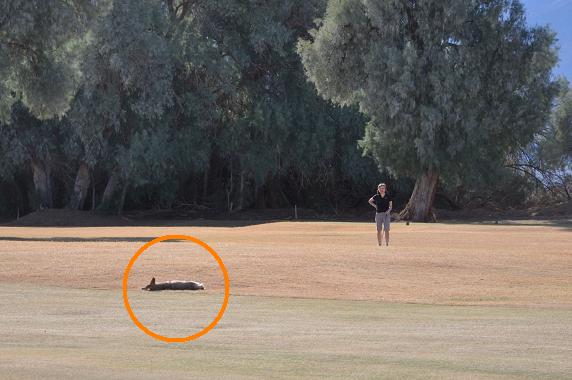
The temperatures in Death Valley at that time were ideal for running but I was not able to run much due to the coyote factor. What made me nervous was how comfortable many coyotes were around humans. This was not long after a teenager was mauled to death by two coyotes in Nova Scotia.
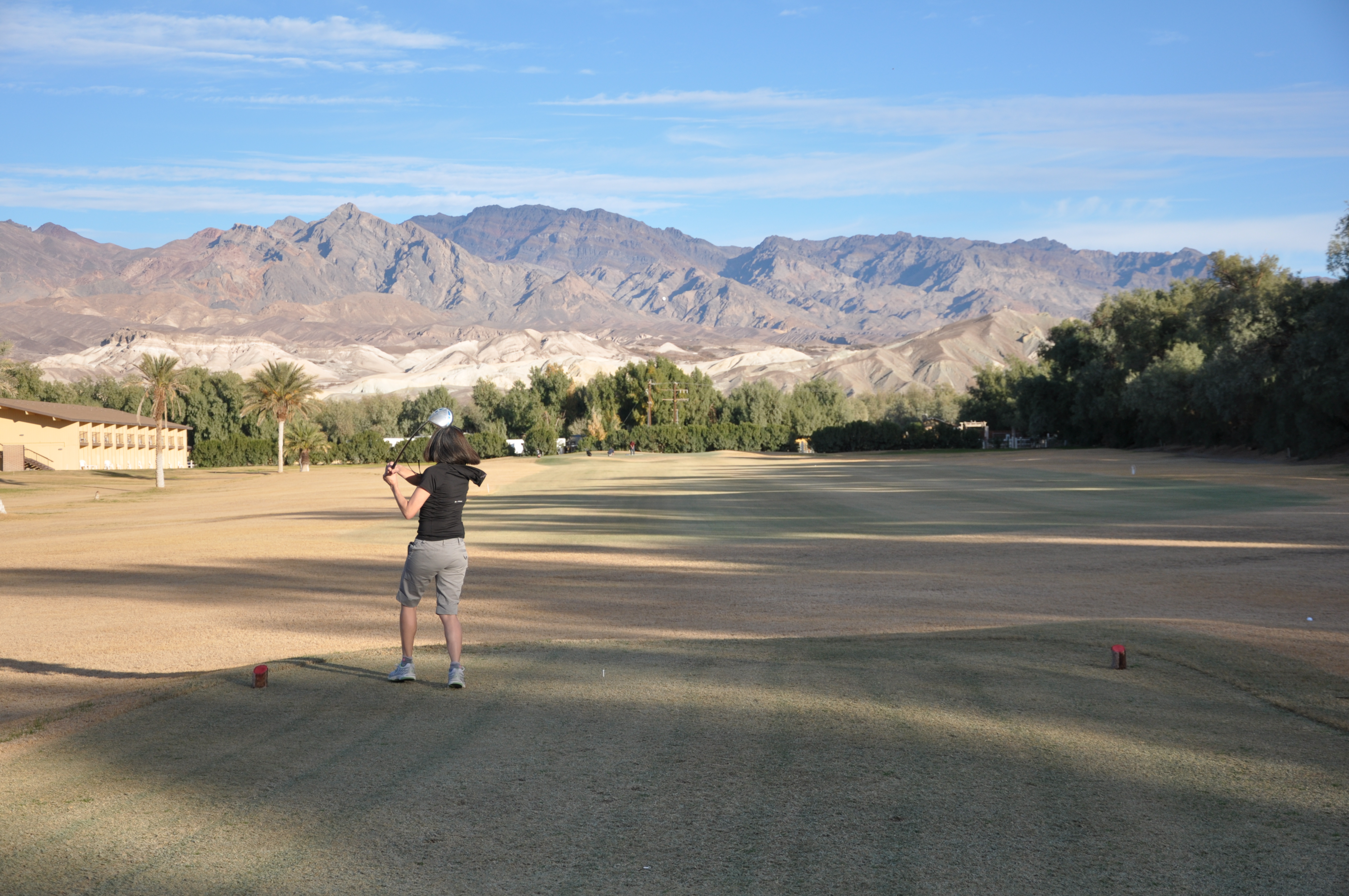
Is it a baseball bat, hockey stick . . . no it's a runner trying to golf.
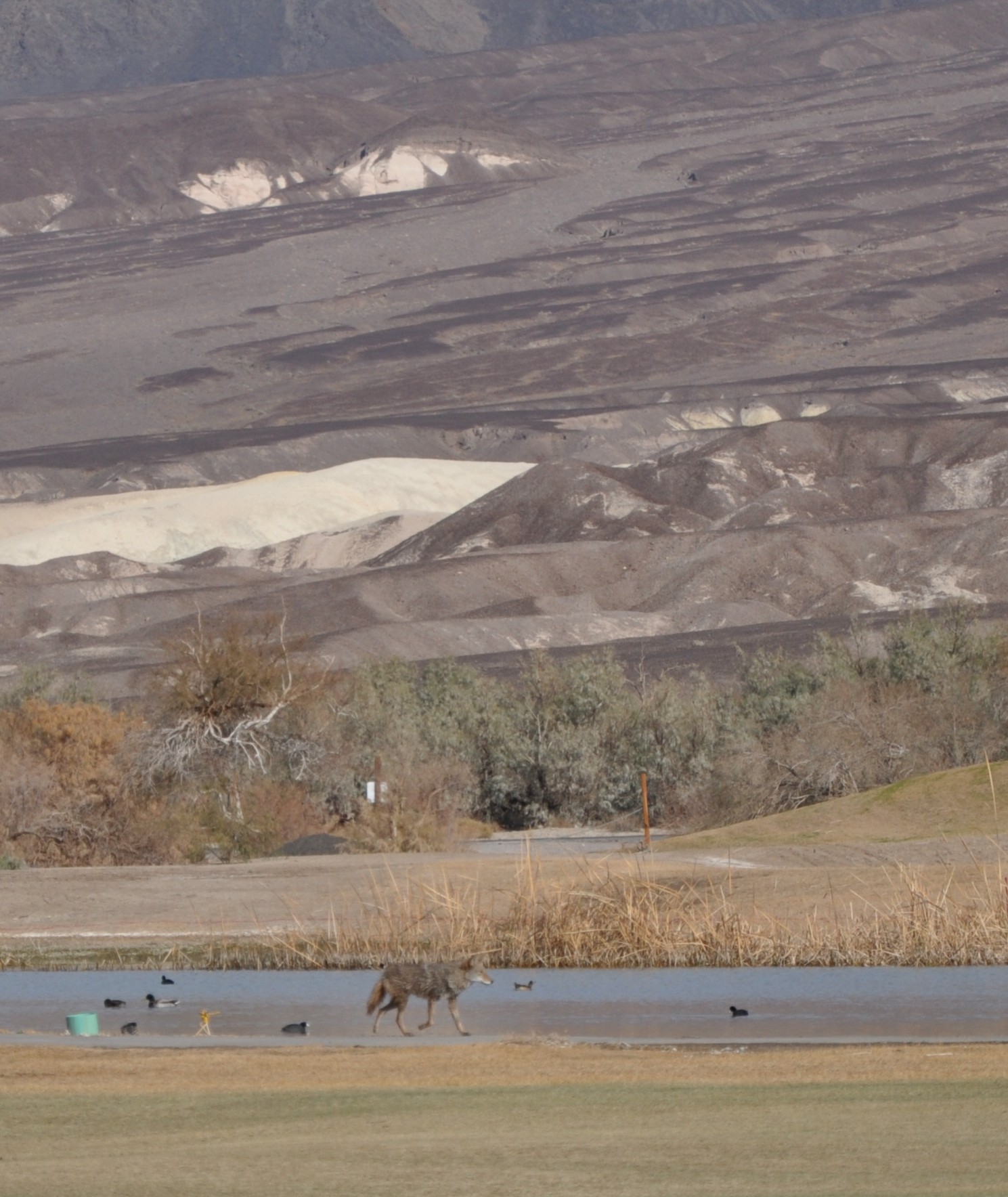
On the prowl for water fowl at the 6th-hole,water hazard.
While golfing at the Death Valley golf course we saw several coyotes, lolling around water hazards, yawning and enjoying a siesta. Notice in the photo below what stands between me, my golf ball and the green, yes it is Mr. Coyote. Which reminds me of our previous golf outing at Prince Albert National Park in Saskatchewan, where a large black bear sprinted across the fairway at the fourteenth hole. Our game ended there and then as we tore back to the clubhouse in our golf cart at top speed. A confession; I’m a bit of a scaredy cat when it comes to wildlife. Once I spotted a very large crow and wondered aloud whether I could fend off a double-team-large-crow attack. I get teased about this regularly.
A hazard of another kind.
Barefoot, the better way?
On one run, I encountered a lone coyote perched on a rock, enjoying the sunrise. I tried to be brave and trotted by, but a few seconds past the creature, I changed my mind, picked up a stone and made a beeline for home base. Although, I do wish I had been running with a camera as I think I would have been brave enough to snap a quick photo before hightailing it back to the compound.
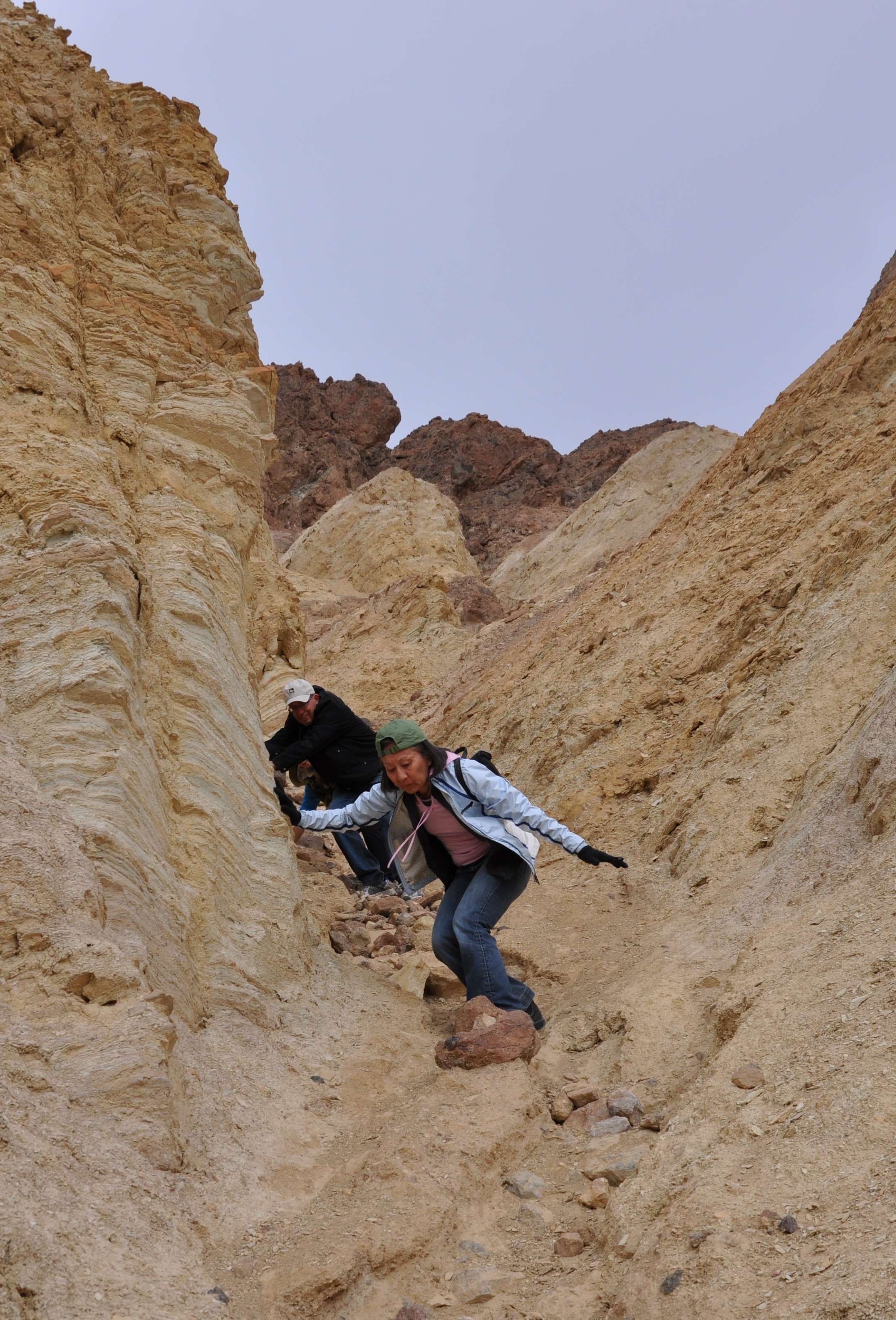
Despite the minimal running it was a very active holiday as we hiked more than we ever have, led by my brother-in-law and his wife, both avid and knowledgeable hikers. It was on our dune hike where my Blundstones shone, as the perfect desert-running boot, although perhaps not quite as ideal as my husband’s choice of barefoot running.
I have no desire to experience the extreme heat of Death Valley in the summer but the gorgeous austerity of Death Valley in the winter with its ideal hiking temperatures, ooh la la!
Me and My Blundstones
Hiking, less hazardous than golf or running in Death Valley.
Way back in the mid-eighties, I discovered the benefits of the easy week. I like to think of myself as one of the early adopters of this principle. The hard-easy day principle of training was well ingrained in anyone who had read articles from Runner’s World and Running Times but not so, the easy week.
One reason for experimenting with easy weeks was having spent half of the my first five years of running – injured. Out of necessity those first five years of running were all about trial and error and a lot of research into how the body works.
Fortunately, I was never prone to running through pain so I did not set myself up for chronic injuries. Just as the body carries the memory of hard-training and top fitness, making the road to achieving this easier, once traveled, my sense is that the body also remembers when the warning signal of pain has been ignored and the time for healing replaced by pushing through or masking the pain, a recipe for developing a lifetime chronic running injury.
The easy week, is all about distribution of effort. The hard weeks are more challenging and the easy weeks, well easier. Over the past decade or more, I was running similar weekly mileage to my peers, as an average, but thrown into the mix, would be some blockbuster weeks of say, over 100 miles and weeks with mileage lower than most “serious” marathoners would consider worthy. The concept of the easy week can be expanded to think of easy years. For example, I knew I wanted to be in the best shape of my life when I turned 50. Leading up to this key racing season, I mixed in an easy year just before. I was increasing fitness, however, I was banking all-out race efforts for when I changed age-groups.
Author - Dr. Jim Loehr
Maximizing performance through distribution of effort can be applied to how we manage our lives. I enjoyed The Power of Full Engagement written by Jim Loehr. He says, “Managing ënergy not time is the key to full engagement and optimal performance.” and I think this is relevant to marathon training as well as life management.
In spite of the faulty analogy Loehr uses to describe his insights, unflattering comparisons of marathoners with sprinters, the basics of what he says rings true for me. As for the analogy, Loehr is a tennis player and his sprinter versus marathoner metaphor demonstrates that he is unfamiliar with the training methods of high-performance distance runners who in fact, must draw on several energy systems to perform optimally.
In running and in life, knowing when is the best time to do what, and the energy demands or complexity of those tasks is a step towards improving RESULTS.
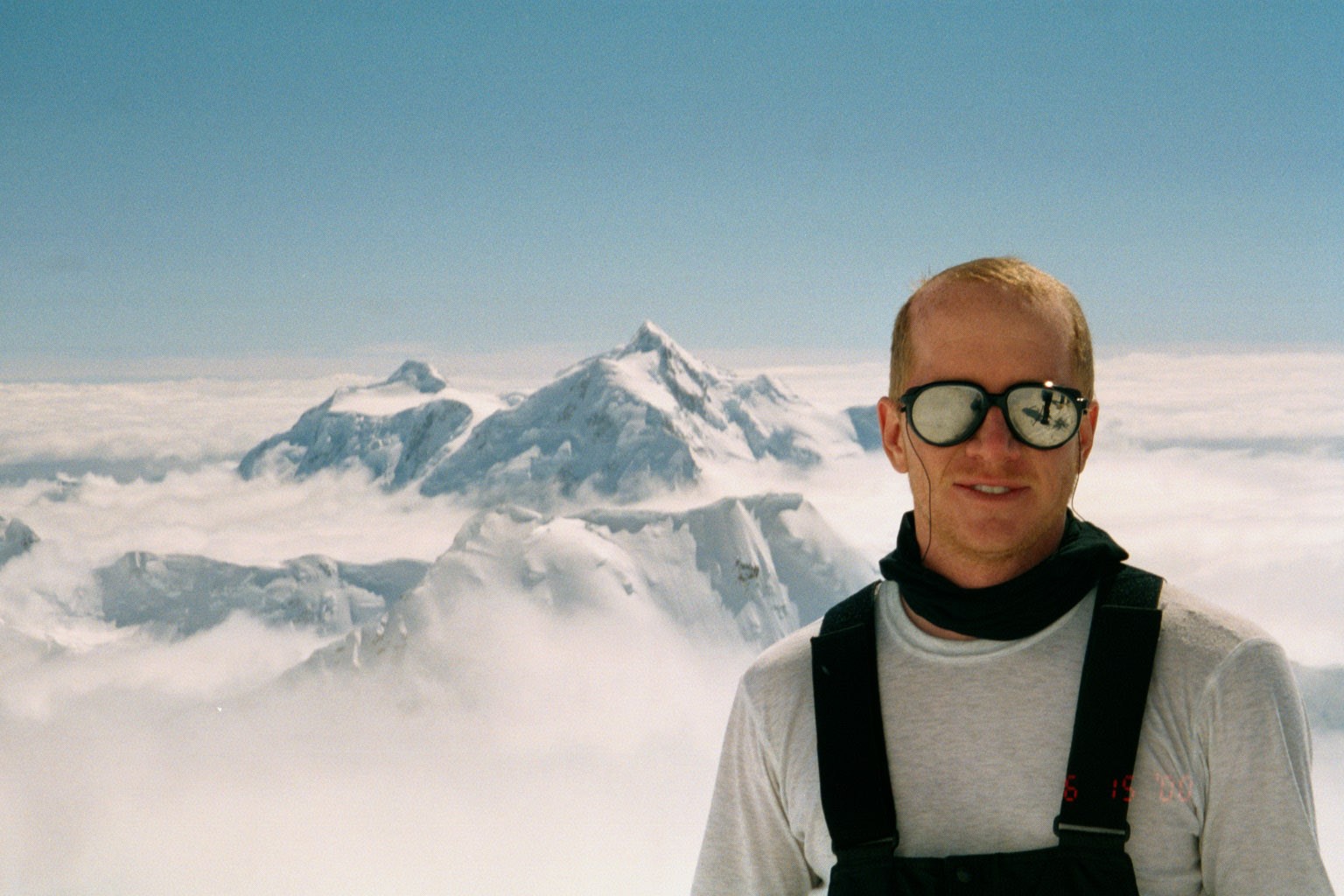
High on Denali, with Peaks of Mt. Hunter (I think) in Sight
Some deal with extreme weather better than others. Here is a photo of my nephew while on a spectacular snowy adventure, climbing Denali, the highest mountain in North America. As mentioned a couple of days ago, I did not fully appreciate the enormity of the feat until seeing a documentary on the topic. Kudos!
My son suggested that his cousin did not want to “crush my dreams” when I made my naive inquiries about trying this myself to which he politely replied, “It is a very technical climb”.
As for two Toronto runners, visiting Edmonton during a time which has the locals saying they can’t remember having this much snow, we escaped the chill with a third trip to Servus Place to run indoors. The drive there bore some similarities to a bobsled event, as we made our way through snow-packed, icy roads that seemed more like snowy channels with snow piled high, all round and well past car height.
I choose to run on the 250 meter indoor track rather than the treadmill. I had run on this track once before, a couple of summers back, barefoot. The track was deserted, making it easy to give barefoot running a try. Today, I realized upon setting foot on the track, that while too busy to run barefoot, it was to be a far better indoor running experience than the treadmill.
The track is larger, by 50 meters, than any of the indoor tracks in Toronto such as York University and the University of Toronto. Running around the fourth, outside lane. six laps will get you just over a mile at Servus Place. Apart from the Louis Riel indoor track in Ottawa, this is as good as it gets for indoor tracks.
Legs come alive on Servus Place 250 meter track.
And thanks to the synergy of all the runners and walkers about, I did my six miles at a brisker than-planned-for pace. Fun!
For the third day, I stopped byBooster Juice for my post-run treat. Today I ordered my favourite smoothie, the Canadian Colada, a blend of pineapple, coconut, bananas, peaches and vanilla frozen yogurt.
All said and done, I agree with Rachel Carson who said, “Those who dwell among the beauties and mysteries of the earth are never alone or weary of life.” to which my mountaineering nephew can attest, I’m sure. However I’ll add that the marvels of an outstanding indoor recreational facility in -26C weather has inspired this snow-weary runner to think of Servus Place, as the 8th man-made wonder of the world.
Yes, at one time the West Edmonton Mallwas a draw for a family with a young boy, who loved swimming with his dad in the wave pool. But for a Torontonian who dislikes crowds and has never been to the Canadian National Exhibitionfor this reason, this white-elphantish mall is on my try-to-avoid list. I do appreciate the sentiment involved in creating large winter-proof indoor venues for one-stop-everything as the weather here is a force. Although, I just checked the temperature in Whitehorse to find -36C, twelve degrees colder than Edmonton at this time.
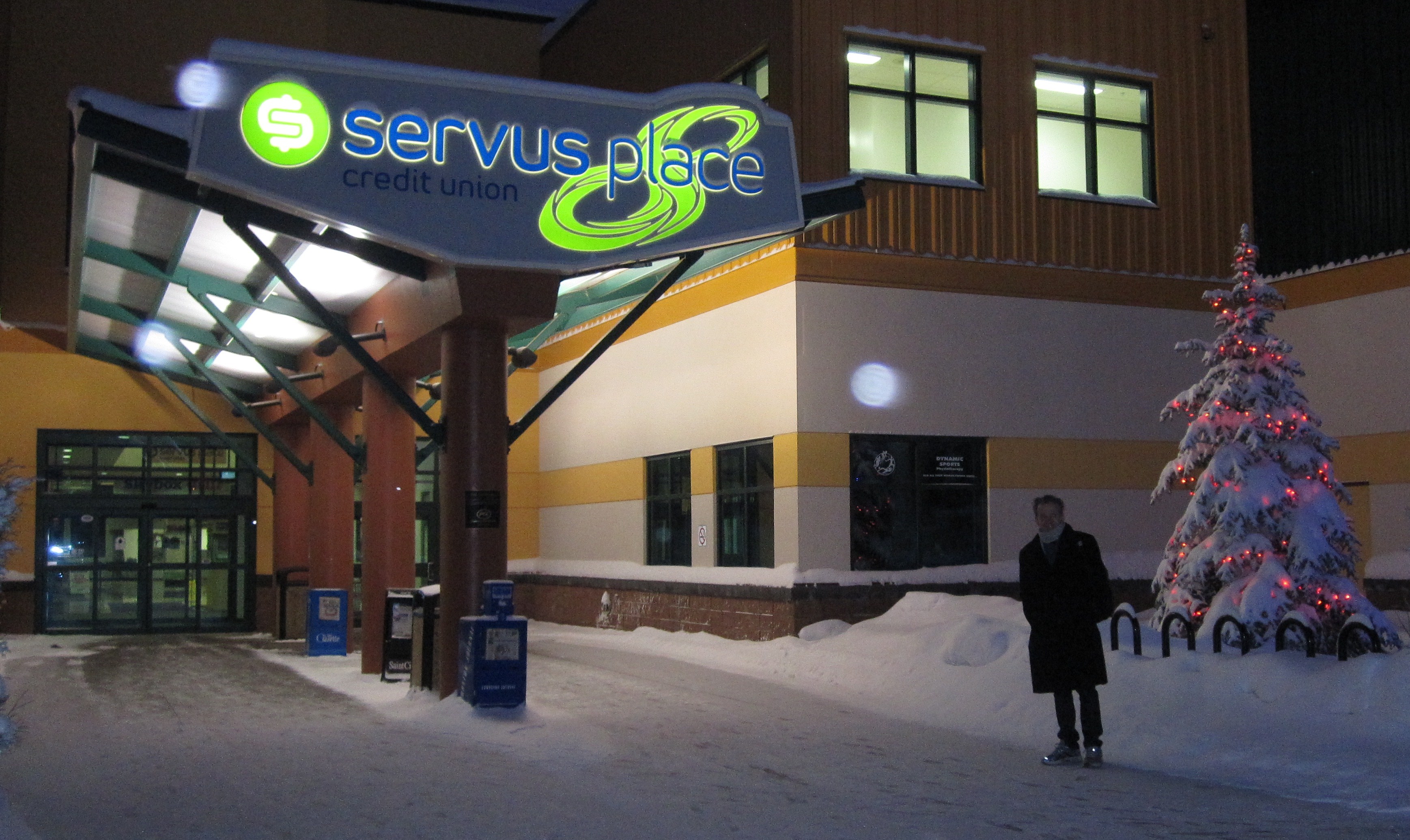
Servus Place at 8 a.m., Saturday, January 15, 2011
My Whitehorse brother has a friend who lives across the river from Dawson City in a log cabin with no running water and electricity. I’m told that the traditional log cabin retains heat very well. Some people are born with the gene for high adventure, the Call of the Wild. Apparently, the friend’s Blackberry works at her cabin. Well that’s a comfort.
Marathoning is about as tame as it gets, with the risk of say, a stress fracture, incurred slowly over many months of running, an injury brought to fruition so gradually that it can take a lot of medical detective work to find out the wherefores and whys.
Ready to Prove Eligible for Seniors Discount
We arrived at Servus Place, our pick for Top Tourist Attraction in Edmonton just before sunrise to beat the rush. It was snowing and the roads had worsened since yesterday, narrower still and more slippery. Once again, my husband remarked that they did not ask him to prove he is eligible for the senior rate.
I ran on the treadmill while my husband ran on the indoor track. Last month, my sister asked me if treadmills have a built in gradual-stop mechanism should the power go off. Today I found out that on the model I was running on, no if the power goes off, the treadmill stops suddenly. This happened twice, a loose wire I guess. On the topic of danger and challenge, well this could be hazardous if running at high speed.
I was watching the Outdoor Life Network while running and was captivated by the travel show, Word Travels. When I say watch, while running it usually means literally watching with no sound as I prefer to listen to music. I tried to plug into the sound but unfortunately the earphone outlet did did not match my earphone plug.
There was coverage of what appeared to be a kind of urban-cross country racing, alley cat bike racing which has its roots in Toronto bike messenger culture and then unbelievably, the two hosts did a jump off the Macau Tower. Unbelievable, to me at least, for whom the excitement of driving in Edmonton is all I need to make me feel like I’m living on the edge.
Let us journey to a lonely land I know. There’s a whisper on the night-wind, there’s a star agleam to guide us, And the Wild is calling, calling. . . let us go.
Our flight to Edmonton was comfortable and passed quickly with a bit of napping and inroads made into The Sea Lady, the sixth or seventh Margaret Drabble book I’ve read which after 120 pages, seems well worthy of the praises sung on its covers. The long drive from the airport to the suburb of St. Albert was another story.
The Edmonton area has been hit with record snowfalls lately, along with very low temperatures making for treacherous road conditions. Shortly after leaving the airport we saw several vehicles in ditches, including an overturned jeep. Along the way, we spotted numerous abandoned vehicles. Later we were told the likelihood of securing tow truck services during this spell of bad weather is very low. Tough going but an evening peppered with my father-in-law’s stories of prairie life on the farm, pre-depression certainly gave us an it-could-be-worse perspective.
View From an Edmonton Parking Lot
As is our habit while here, we had our coffee and then drove to the Servus Centre for a morning work-out. Upon arrival we noticed that it was the busiest we have seen it and discovered that it was the second day of The Continental Cup, a world-class curling tournament featuring competition between the best teams from North America and the best in the world.
Curlcast coverage included this news item. “Andrea Schoepp doesn’t have the use of a bicycle during the Continental Cup at the Servus Credit Union Place this week. If she did, the current world women’s curling champion skip claims she’s be riding from the hotel to the arena and back every day, and never mind the minus-20 temperatures or the ice-bound streets. “Oh yes,” she was saying this week, “you don’t have it cold here. This is great weather. Definitely not too cold for biking.”
Um, well, I beg to differ. Sounds foolhardy and life threatening. Is this bravado the equivalent of curler’s “trash talk”?
As my husband was about to hand over our entrance fee, I interjected excitedly, “Hey look, YOU are a senior!”. As the attendant reworked the total, he joked that he was disappointed that she did not ask him to show his I.D. Said I, “I don’t think that is the first time she’s heard that joke”. At this juncture my observation may not have been wholly appreciated.
I ran six miles on the treadmill, did upper and lower body weights and was pleased to see that they had the sled style leg press machine. You should definitely have a trainer in your gym show you how to use this machine and if a novice, should start out with no weights. The lock and unlock feature on this machine varies a great deal so be careful if you are using a new machine. The demonstration below is a good one.
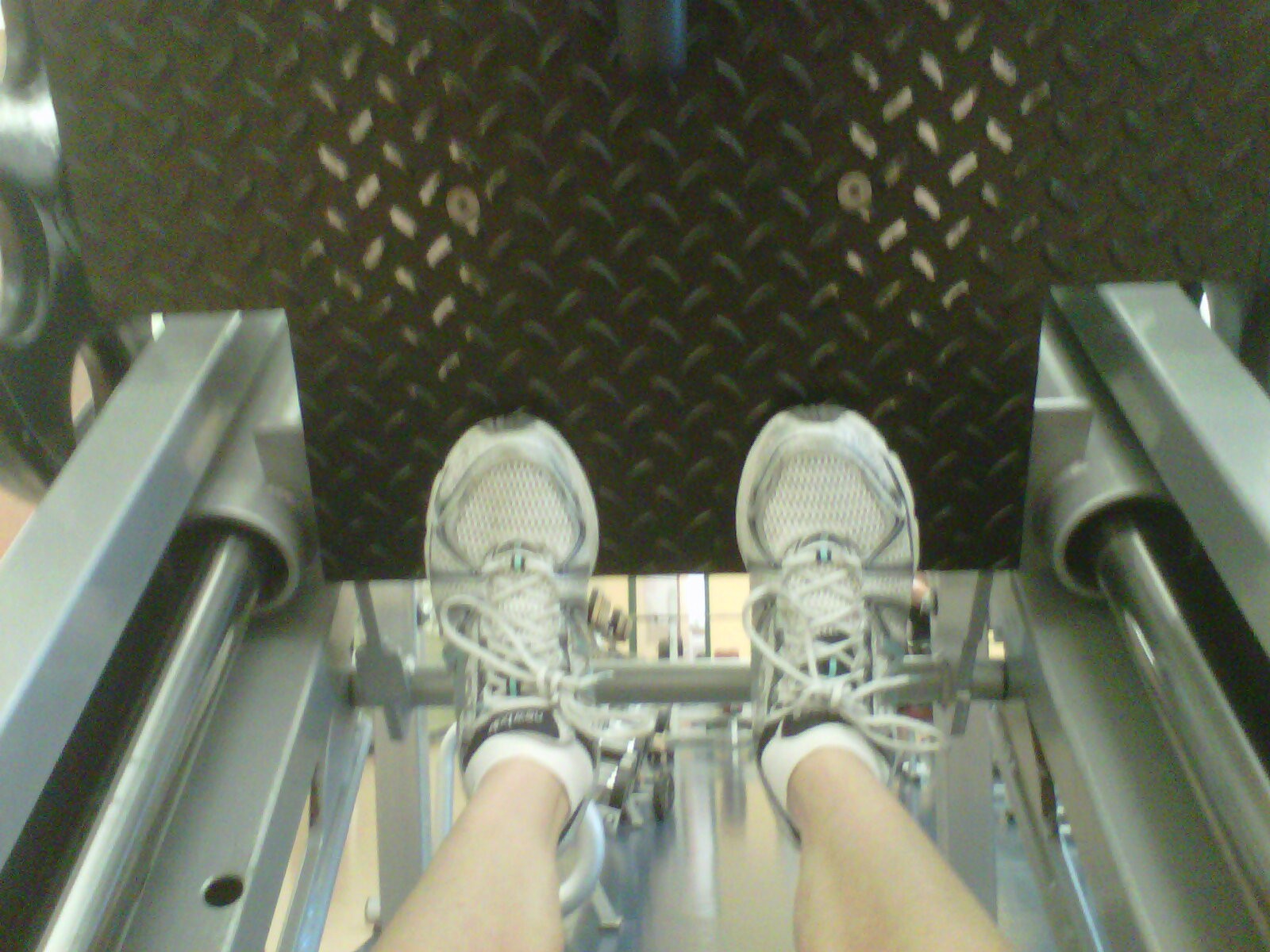
I also do ankle raises on this machine by positioning the balls of my feet at the bottom of the machine and flexing the ankles up and down. You don’t unlock the machine for this as the range of movement does not require unlocking and to do so would put you in a vulnerable and dangerous position.
View of My Feet in Position for Ankle Raises on Leg Press at Servus Centre
Workout done, I stopped by Booster Juice for a Ginger Hammer, a mix of apple, carrot and ginger juice as an appetizer to a regular outing during our Edmonton visits, a trip to Ricky’s restaurant. My usual choice is one of my indulgences, like my love of poutine, one of four Big Breakfast choices called the Perogy & Egg Platter which includes; 3 eggs, 7 perogies and Bavarian or Chorizo sausage and toast.
Perogy & Egg Big Breakfast
With the 1 p.m. timing of our breakfast, I devoured this treat with gusto, save for two perogys and 1/2 an egg. Certainly, not the basis of a healthy lifestyle but a reasonable twice-a-year meal for an omnivorous runner with no family history of heart disease. And there is something to be said for insulating layers of fat when living at minus 26 Celsius.




 $$
$$













 Mind, Motion & Matter