Hear what Joan Benoit Samuelson, two years my junior, has to say about growing up as a runner, as Title IX introduced in 1972 opened up a “myriad” of opportunities for women in the U.S. Joan Benoit is the winner of the first Olympic marathon for women held in Los Angeles in 1984.
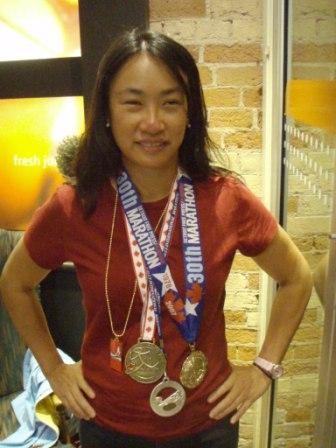
I celebrated my 40th birthday by running four marathons in a month. Why? I have always been into hero worship, particularly those who have survived great feats of endurance – Magellan, Shackleton and Dean Karnazes. Although I wish to follow Karnazes’ footsteps, I was not prepared to run 50 marathons in 50 days. However, the number four has been lucky for me and running four marathons in one month seemed like a worthy challenge. I even had a name for this endeavor – Four for Forty. The four marathons would be: the Toronto Waterfront Marathon, the Toronto Marathon, the Detroit Marathon and the Niagara Marathon.
Both marathons in Toronto were excellent training runs and I was able to train for upcoming marathons in conditions that could only occur during races – high traffic water and gel stations, and dealing with ‘runners’ high’ at the beginning of races.
Four For Forty!
At the Detroit Marathon race expo, I told Dick Beardsley about my Four for Forty challenge. Beardsley, along with running legend Alberto Salazar, participated in one of the greatest duels in marathon history – the 1982 Boston marathon – where they battled stride for stride for more than two hours with Salazar edging out at the end. This remarkable race was chronicled by John Brant’s book titled,Duel in the Sun. When I bought the book, Dick Beardsley personalized a message on the front cover. He called me “The Marathon Queen”. That short message brought a huge smile to my face!
The Detroit Marathon was the closest to the spirit of a 40th birthday celebration. The start was preceded by best wishes from celebrities including Haile Gebrsehassie. Gee, what a treat! Even the world record holder wanted to be partake in my birthday celebration! My finishing time in Detroit was a spiritual sign that I was meant to pursue this challenge – achieving my personal best marathon time of 4 hours and 40 minutes during my Four for Forty challenge!
The Niagara marathon had its own set of “memorable moments”. How can I forget getting a police escort to the start line and having cups of water handed to me by bikers in Halloween costumes! But I received a remarkable gift during my run from Buffalo to Niagara Falls – a consciousness that I was becoming more confident in myself to pursue ambitious challenges that I had always dreamed of.
With each step, I was starting to believe that I always had the resources – aptitude and attitude – to pursue ambitious dreams, whether they be summiting majestic peaks, paddling temperamental coastlines or cooking a home-cooked meal. What this Four for Forty challenge made me realized was that with proper planning and risk management, I could follow the footsteps of my heroes, or even create my own footsteps. I can now take this trust in myself and use it to pursue other ambitious dreams on my life’s must-do list. When I crossed the finish line in the Niagara marathon, I felt blessed as I had become one of the heroes I always wanted to emulate.
So what did I get for my 40th birthday? Not a Porsche or a surprise party, not even new athletic gear. I did get four marathon finisher’s medals, and a realization that I have become my own hero.
Snow, snow, snow . . . will this storm materialize as predicted? I thought this might be a good time to list the different indoor venues where I have done long runs when poor conditions prevailed. In days of yore, treadmills were not available at fitness facilities, so most runners slogged it out on the roads. I’ve always been finicky about poor footing due to chronic ankle troubles stemming from having severely sprained my ankle at age 13 on a trampoline. Consequently, I’m usually the first to head indoors to find relief from slipping and sliding outdoors.
I once ran 18 miles on this track, a total of 4955.5 laps in the early-eighties. David Suzuki used to be a regular on this teeny track.
Former Central YMCA on College Street
The West End YMCA
15.5 laps to the mile.
I ran a full marathon, 26.2 miles here in the mid-eighties, a total of 380 laps.
Hart House Track at the University of Toronto
About 11.3 laps to the mile
I’ve run 12 miles on this track. Although it is bigger than the old Central YMCA track the banking is horrible and I would not recommend doing a long run here.
The Athletic Centre at the University of Toronto
8 laps to the mile
About 6-7 years ago I ran 23 miles on the outside track and ran by time rather than counting laps. Who says we don’t get smarter with age.
The York University Track
8 laps to the mile
I’ve run a number of track races on the indoor track, which has excellent banking and run on the outer warm-up track before and after workouts or races. I’ve never done a long run there but I imagine it would be fairly entertaining with all the high-performance activity on the inside track. My husband and I used to see the infamous Ben Johnson work out on the sprint lanes.
The Eaton Centre
One New Years Day in the eighties I ran a few miles here, having started outside during a snowstorm, I ducked inside and logged some miles in the mall.
Treadmill
The most miles I’ve run on a treadmill is 18 miles which I did a few years back.
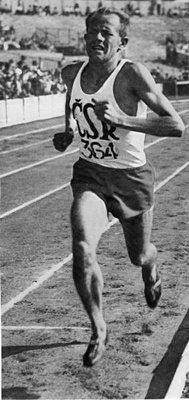
If you think this sounds crazy consider this, legendary marathoner Emil Zapotek’ssolution to training in harsh weather. Zapotek would fill his bathtub with water and then his laundry and run in place for hours. Zapotek is remembered for winning triple gold in the 5K, 10K and marathon at the 1952 Helsinki Olympics.
According to some mental health experts, Monday, January 17thwas the most depressing day of the year. Mainly due to the arrival of bills in the mailbox and gloomy weather. In addition, by this time, many will have abandoned New Years resolutions, short of the 21 days that it supposedly takes for good habits to take hold.
I don’t usually make New Years resolutions as I find that September is the month when I feel most upbeat about tackling new projects. It must be all those years of mom-hood that have me stuck in the school-year cycle. Today however I feel the need to resolve to reduce my sugar intake for the rest of the year.
The reason for this belated resolution is that I have not quite recovered from the holiday season sugar overload and I’m hooked, with the energy lapses and subtle mood swings to show for it. Some have called refined sugar consumption, “Death by installments.” I read and was influenced by the book Sugar Bluesin the late-seventies and this coincided with my return to regular exercise after a five year lapse. The results of these two important lifestyle changes were that my energy level became very consistent and stable through the day. Mid-afternoon sleepiness and drowsiness after meals can be avoided by reducing the refined sugar in our diet, and foods ranking high on the glycemic index.
Here is an enthusiastic review of the Sugar Blues by a more recent reader:
A true health classic! February 3, 2000 Reviewer: A reader from New York City
I’m sugar-free ever since reading “Sugar Blues.” I was sluggish, moody, hungry, etc. I remembered that John Lennonmentioned Dufty’s book in an interview once. So I bought it at the local health food store. He starts off with his own sugar hell and redemption and then delves into the whole history of the cane. Very interesting, health-wise and also politically. . . When I tell people I’m sugar-free they usually scoff, saying sugar’s not that bad for you, why give it up completely. Well, now I wake up clear and I get through the afternoon w/o any flagging of energy. At various times of the day I’ll feel some energy racing through my body. (A great feeling; keeps me motivated.) Now I need less food on my plate, and my hypoglycemia has all but disappeared. (Think about THAT one, folks.) Never eat “refined sucrose” again! It can be done! Sky’s the limit! Thank you, William Dufty!
Sugar Blues by William Duffy
Apparently, John Lennon used to regularly give away copies of Sugar Blues. Well I’m a believer in “baby steps” so here is what I did today to lessen my sugar intake, I had a non-sweet latte, at LIT, foregoing the usual triple-venti-whole-milk-vanilla latte and I skipped a sweet treat. Once I’m back to minimal sugar consumption, a sweet treat can be enjoyed every now and then without ill effect and it will be truly a treat rather than the satisfaction of an unhealthy craving.
I won’t delve into the more serious issues related to blood sugar levels such as Diabetes for which my knowledge is limited to first-year Biology and Nutritional Food Science but one starting point might be this link to The Canadian Diabetes Association.
LIT Latte Art
Here is a great quote from Jack Lalanne, the Godfather of Fitness who passed away recently at the age of 96.
Exercise is King, nutrition is Queen put them together and you have a kingdom.
Today I lunched with a friend who is helping my husband and I organize a gala for a sponsorship program for AIDS-HIV orphans in Ethiopia. The program is supported mainly by volunteers, here in Canada is run by People to People Aid Organization, Canada Inc. . Thus I thought it would be timely to profile one of Ethiopia’s finest runners, Fatuma Roba who was the mother of five children when she won the Olympic gold medal.
Born in 1973 and raised in the village of Cokeji in Ethiopia’s mountainous southern region—also home to internationally known 10K champion Derartu Tulu—Roba was one of seven children born to a farming couple who raised and herded cattle. Like most children growing up in rural Africa, if she wanted to go somewhere, the quickest way to get there was to run. The daily run to and from her school—much of it going up and down hills—trained the young Roba in the art of sprinting. As a child her hero was 1960 and 1964 Olympic marathon champion Abebe Bikila, a fellow Ethiopian. After completing school, the five-foot-five-inch Roba decided to train to become a police officer after her performance at a national cross-country championship caught the attention of members of the Adis Ababa prison police athletic team.
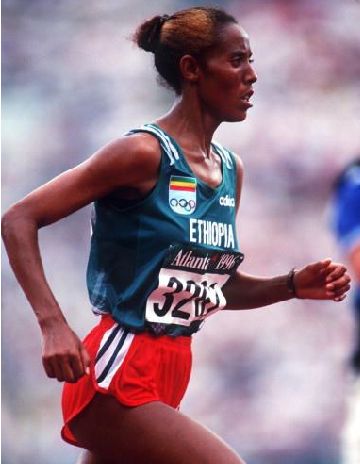
Fatuma Roba, Fluid Grace
Roba first gained an international profile in 1990 when at age 18 she placed fourth in the 3,000 meter and 10K competition during the African Championships. Three years later she decided to attempt the 26.2-mile marathon distance in her home town of Addis Ababa, and had reached a personal best time of 2 hours 35 minutes 25 seconds by 1995. Roba continued to reduce her marathon time throughout the spring of 1996, helped along by the coaching of Yilma Berta. To train to excel at the 26.2-mile marathon distance, the 22-year-old Roba logged an average of 125 miles a week, most of it at high altitude, thereby forcing her body to use its resources of oxygen efficiently. She ran and won two marathons early in 1996, the first in January at Marakech and the second in Rome, Italy, two months later.
When Roba joined the field of the 1996 Olympic women’s marathon in Atlanta, Georgia, in July of 1996, she was ranked only 29th among the elite women athletes assembled there. Surprising almost all onlookers of that years’ Summer Games, she managed consistent five-minute miles, gained the lead by mile 13, and left behind Japanese runner Yuko Arimori, who had won the silver at the 1992 Summer Olympics in Barcelona, Spain. At mile 19 timers clocked her race pace at 5:21; relaxed and alert, Roba waved as she passed, the crowds cheering on the first woman in the pack. She went on to cross the line in 2:26:05, her lead a remarkable two minutes. “This is not only a special thing for me but also for my country and all African women,” Roba was quoted as commenting by Amanda Mays in the Philadelphia Inquirer. “The Ethiopian women are coming up in the marathon. This was the breakthrough and now we are ready to challenge the others.”
Roba’s success in Atlanta was balanced by an equally notable performance in 1997 at the 101st Boston Marathon. She gained and held an easy lead by mile 20 to win in 2:26:23. The first African woman ever to win the historic Boston race, Roba bested an elite field that included defending champion Uta Pippig, Japan’s Junko Asari, and South African runners Colleen de Reuck and Elana Meyer. “She ran with the same smooth stride and placid, dispassionate look on her face that she carried through the Olympic race,” reported Runnersworld.com. “Race commentator (and fellow Olympic marathon champion) Frank Shorter called her ‘The most relaxed-looking runner I have ever seen.'” Roba’s performance at the World Championship Marathon held in Athens, Greece, the following fall was a disappointment when she was forced to leave the course after being injured.
One for Ethiopia!
In 1999 the 25-year-old Roba took her third straight win at Boston, her time a personal best of 2:23:25 that set a new women’s overall course record. She won the silver at the Tokyo Marathon with a time of 2:27:05, but at the World Championships in Seville, Spain she finished a disappointing fourth. Roba’s winning streak at Boston ended in 2000, when she fell to third, barely losing the Boston gold to Kenyan runner Catherine Ndereba in one of the closest finishes in Boston Marathon history. Like Seville, the summer heat in Sydney, Australia proved hot enough to stall Roba, who finished a disappointing ninth at September 2000’s Sydney Olympics with a time of 2:27:38.
Like her hero Abebe Bikila, Roba has become a role model for African runners, women runners in particular. Her own younger sister, Sennaito Tekru, has followed in her path, and has embarked on a course as a competitive marathon runner. With her grace and seemingly effortless performances, Roba has broken the barrier for African women with her triumphs at both the Olympic Games and the Boston Marathon. Despite her disappointment in Sydney, she has continued to rank among elite women marathoners, handily winning the San Diego Marathon in 2001 with a time of 2:27:22.
The most lame excuse I’ve recently heard for not exercising is “I can’t afford a personal trainer”. One of the appealing aspects of staying fit is that it is something that money can’t buy. Walking and running are the most accessible forms of exercise and all it takes is a pair of comfortable shoes. One of the reasons African runners are able to realize their potential in the sport is that running does not require expensive equipment, gyms and pools or a horse. The simplicity and accessibility of running makes it the MOST competitive sport in the world.
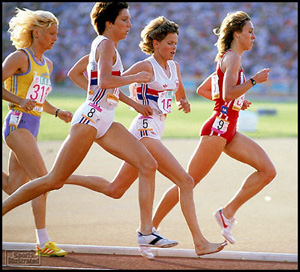
Zola Budd Running Barefoot in Olympic 3000 Meter Race
A friend once referred to certain sports as “country club” sports, the Modern Pentathlon and equestrian sports for example. With all due respect to those who participate and excel in these sports and those outside the typical demographic for that sport, the global talent pool which running draws from exceeds that of any sport by a country club mile.
Most everyone in the world has at one time in their lives run a race be it formal or informal, school races or racing to catch a bus or to catch or escape from playmates.
When a girl, our family paid regular visits to relatives in a neighbouring suburb. Their home was on a crescent and our route there, had us drive to the top of the crescent and loop back around a bend near a walking path connected to an earlier part of our route. I would have my dad let me off near this shortcut and I would run furiously towards my cousin’s home hoping to arrive before the car. I always won! Thinking about this now, I never gave thought at the time as to whether my dad purposely let me win. I will have to ask him about the legitimacy of this unbeaten streak.
Maria Mutola, 800 Meter Runner, Amazing Woman
Maria Mutola, perhaps the most successful female runner in history was “discovered” running barefoot while playing soccer in Mozamique, one of the poorest countries in the world. An Olympic gold medalist, she is the only athlete to have successfully earned the $1,000,000 Golden League prize for consecutive wins in this series and upon retirement returned to her first love, soccer. You can read an interesting account of this running heroine in the Guardian article Maria Mutola still leads from front – but in South African football.
All this to say, if you are convinced that you will improve your quality of life both mentally and physically, by adopting the habit of regular exercise, I advise you to just get out there and “Do It!” or as this more recent Nike ad says, “No Excuses!”
This is my 30th year of running. My first goal was to run a marathon when I turned 30 but I ended up running a marathon a few months later at age 26. It was my first long-distance race ever! There were no run clinics back then so I used the 3 month marathon training program published in Runner’s World.
Sunday September 12th is the 30th anniversary of the Terry Fox Run. The Terry Fox Run was the first measured route that I had ever run. Years later I organized Terry Fox run sites at my son’s school and at our neighbourhood YMCA.
Behemoth
Tiny
30 years ago the Sony Walkman which played cassette tapes, first began to appear in North America at high-end electronics stores like Brack Electronics. One of my brothers worked at Brack Electronics and I was the first kid on the block to own one.
I wonder sometimes if I was the first runner in Toronto to run with a Walkman. This thing was huge, about 10 times as thick as an IPod, 5 times as wide and 5 times as long. Imagine the ingenuity required to strap this thing on without the help of special belts and carrying cases. Now I run with a camera and IPod that together are barely 10% that size.






 Mind, Motion & Matter