
Mind, Motion & Matter

Running, Essentially . . .


Leave a comment

First stop Sacramento

For someone who is used to running high-mileage in marathon training.  Running 50 miles a week hardly takes a thought.  I run about an hour a day with a 2 hour plus run on the weekend – this is the default.   However, with 15 weeks until my pre-Boston, marathon outing in Sacramento, the moment has come to either train seriously, forget about it or suffer in the final miles of the race.
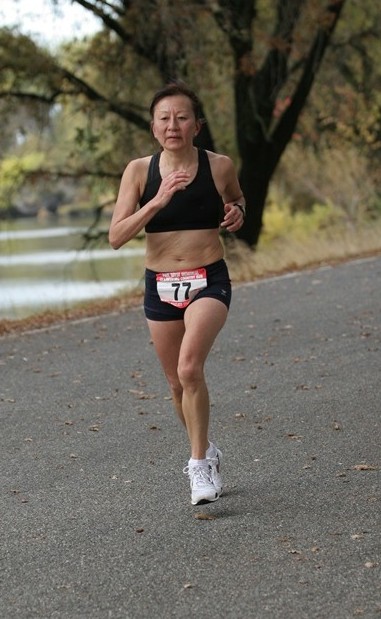
2007, Sacramento 30K

So, I’m formulating my plan and the mileage build will go like this 57 miles this week, 61 miles next week and 57 miles the following week (including a rare day off for travel).  I like to do 2-3 solid weeks of building miles and then take an easier week.  Fortunately, this easy week will coincide with a trip to Germany.  My long run will increase from 12-15 miles to 17, 18 and up to 22 miles.

In addition to the increased mileage I have to start speedwork.  I’ve committed to hitting the track with a group.  For the past two years I’ve been taking evening courses, this year I will go to track school.  I’m excited about running on the new Varsity stadium track.  The very scene of my first marathon finish.  The coach, Paul Osland is a former Olympian who is now whipping a group of motivated masters into tip top shape.  I’m apprehensive about the return to the intensity of speed work.  My fast running for the past two years has gone something like this . . . run fast when I feel like it for 30 – 120 seconds.  Take as much rest as I need.

From what I can tell, the plan for Thursday is to run 150 meters at a very fast pace, 18 times and the do it again for a total of 36 fast repeats.  Then we are to bound up stairs, 2 steps at a time, 5 times and then repeat.  I’ve never done circuit training, of which we are to do 4 laps.  Hmm . . .

This could be painful.  Given that most of these runners will be peaking in the early fall, and my timing of a December marathon is unusual, I hope to get some sort of just-starting-out dispensation. I’m reminded of how once, when in top form I remarked to another runner as we readied ourselves for a grueling session a la Zeba Crook that his workouts were effective because they helped us to increase our pain threshold.  The runner turned to me and said, “but that is not what I signed up for”. No doubt . . . I’ll soon have a tale to tell.

Gulp . . .


Leave a comment

Last day of work

Moving Day

I set out for my pre-work run later than usual as I only had to log a few hours today, my last day of work at my place of employment for the past two years.  While running I listened to my Dave Allen, “Making It All Work ” book and then some quiet music, Keith Jarrett’s “The Melody at Night With You”, in order to meditate a little on the upcoming changes.  My husband and I saw Keith Jarrett, Gary Peacock and Jack DeJohnette perform at the Four Seasons Centre for the Jazz Festival earlier this summer.  The performance was superb, consumately emotional and priceless!  It had been 25 years since I had seen this same trio perform and seeing them again, has enlivened my enjoyment of their music.

I start my new job on September 7th.  This is the same day that my son starts his internship at Research in Motion.  He is a software engineering specialist in U of T’s Computer Science program.  His salary as a student intern will exceed what I was earning at my former workplace.

Earlier in the week my husband helped me cart home the enormous amount of stuff, that I had let accumulate at work.  Included in this was a lot of running gear, my foot masager, oodles of personal care products, lots of framed photos, numerous hand-crafted ceramic gifts given to all staff from our creative and generous information resources coordinator and a few books including a copy of “Japanese Death Poems”, “Jack Daniels Running Formula”, “Beloved, Henri Nouwen in conversation” and a Microsoft Access reference book.    The death poems were written by Zen monks  and Haiku poets on the verge of death.  Ive posted a sample in the WORDS section of my blog.

I’ve used Jack Daniel’s book extensively to guide my training and as far as training books go, it is in a league all its own.  I gave my copy to Nelson Njeru, a 2:10 Kenyan marathoner who gave a boost to the  George Brown College cross-country team when he began some studies there and signed up to run for them! Nelson, I should mention is now in his forties.

Questions about what my new workplace will be like percolate.  Will I be able to muster up a team for the Bay Street Rat Race or Corporate Challenge ?  Will the golf course across the street have a driving range I can go to at lunch?  I am an ultra- novice golfer but I do find it fun.

As for farewells, I was given a gorgeous floral arrangement and taken out for a delicious lunch by two colleagues.  We called it the tri-level lunch (inside work joke) and caucused a little on big picture work issues.  I made a lot of friends at my workplace and while I look forward to a wonderful new career opportunity I will miss them.  Maybe I’ll be invited back for the holiday party given my status as two-time holiday party committee member.

Many of the “good-byes” involved resolutions by my co-workers to start or stick to a fitness routine.  I seem to have that effect on people  🙂

Adieu, adieu!


Leave a comment

Spend your energy wisely!

The title of this blog was originally the title of an article I wrote on heart-rate monitor training. One of these days I will retrieve this article which resides on the hard drive of an old computer; but for now a few thoughts. A runner wishing to gain fitness, is well-advised to train with a heart rate monitor and arm themselves with their personal heart-rate-training-zone statistics. Just as you would not want to spend more dollars on a item than necessary, so too, most would not want to expend more energy than necessary to get fitter and faster. The cost of this over-training or hyper-training is most often injury.

Detroit marathon

Detroit Marathon 3:11 finish on Ford Field

I had lactate threshold testing done at the Endurance Lab in Toronto as something of a guinea pig. Training zones for individuals are quite variable and tables for training zones express an average only, which can can vary up to 20 beats or more from one person to another. With your personal data you can incorporate threshold running or tempo runs, along with speedwork (near maximum effort) in quantities that will help you to run faster at the minimum energy expenditure. Running at the minimum, means less stress to the musculo-skeletal system, which is most often a runner’s weak link. Find out more about the test itself by clicking on Endurance Lab.

Having run for a decade or so with a heart rate monitor, I had developed a sense of what my training zones might be. Prior to getting the results I made some guesses as to my zones and Adam Johnson who administered the test conceded, when reviewing the results, that he probably was telling me what I already knew. That may have been so, however in addition to the decade of training with the monitor, I had an additional 15 years of marathon training experience and an intuitive sense of how to use a hard-easy training regime.

Back in the day, the early-eighties, specialized running gear was hard to come by. Some frugal runners, like me, took pride in the low cost of the sport and thought it frivolous to designate a regular pair of mitts to running, and wore socks instead of mittens. While today’s gear might make training more comfortable, affordable heart-rate monitors and lactate threshold testing are at the top of my list of how to maximize fitness dollars and improve your understanding of how the body works.

Recommended: Polar heart-rate monitors, a starter version can be had for about $100. The New Balance store will handle any repairs or battery changes for Polar products in (roughly) 10-14 days. Invented in Finland in 1977, the first wireless Heart rate monitor was used as a training aid for the Finnish National Cross Country Ski team.


1 Comment

Blogging towards Boston

It has been over two years since I have run a marathon. The last, was Boston 2008 and my time of 3:22 fell a bit short of my hopes.  The year before I placed 3rd in my age group with a 3:17.

My claim to fame is having qualified for Boston at the age of 50, in 3:10, the qualifying time for Open Men (under 35).  As far as I know, 3:10 remains an Ontario age-group record for the marathon.  The qualifying time in my age-category is 4:05.  I’m planning to run Boston 2011 so it is time to start building mileage and inject more intensity into those miles.

Boston marathon 2008

Here I am in 2008, alongside some of those “Open Category”  men.

Currently, I’m running 45-50 miles a week with little high-intensity stuff.  Where am I going to find the time to run another 20-50 miles a week?  And, the motivation to run many of those miles at a very fast pace?

The key elements of marathon training are a long run, a tempo run and interval workouts.  I don’t mind the long run.  Strangely, there is nothing I find more satisfying than the depletion following a run of 18 miles or more.  You can get hooked on that feeling.

Intervals are another story.  It seems unlikely that I will find it in me, to do the 6 x 1 mile workouts at 6 minute pace with a 2 1/2 minute break, that I did a few years back under the tutelage of my coach, former elite steeplechaser and now professor of religion, Zeba Crook. And the tempo runs of 4 x 20 minutes at half-marathon race pace?  Who was that crazy woman?