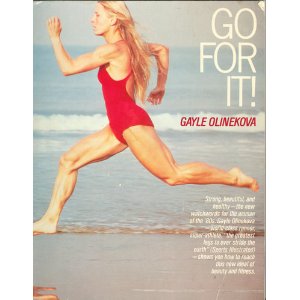
Following my post about weight training, a reader asked for recommended reading. I was reminded of this groundbreaking book from the early 80’s by Gayle Olinekova which inspired me to begin my weight training routine. Gayle was ahead of her time in that she incorporated weight training into her marathon training schedule. This former Torontonian ran world-class marathon times and yet felt a little embarrassed about her very muscular legs, which did not fit the typical marathon runner mold or the prevailing feminine ideal. Eventually, she was discovered by Sports Illustrated and covered in an article called The Greatest Legs to Ever Stride the Earth.
Photo by Helmut Newton
Sadly, Gayle died in 2003 at the age of 50. Gayle’s book Go For It! was written at a time when books on athletics written by women were almost non-existent. It may be out-of-print but available used.
Go for it!
I can claim a shared experience, as she was at one time a member of the Toronto Olympic Club which I belonged to for a few years. From wanting to hide her legs to inclusion in Helmut Newton’s “Strong Women: A Portfolio of California’s Super Athletes” Gayle can be given credit for blazing a trail. Here is part of an obituary from the Los Angeles Times.
Gayle Olinekova, a marathon runner and fitness guru whose chiseled, muscular legs helped change cultural views about beauty in female athletes in the 1980s, has died. She was 50.
One of the activities keeping me busy lately is my #1 Goal of 2011, which is to raise funds for a sponsorship program organized by People to People AID Organization (Canada) Inc. We have a personal connection to the dedicated individuals involved with this program and have done a lot of research to feel assured that funds are well used to benefit children who have been orphaned in Ethiopia because of HIV-AIDS.
C5 - Fabulous City Views on 3 Sides
I’m so very happy to announce that we have firmed up the venue and the date for the fundraising gala my husband and I are organizing. It will be held on Tuesday, May 3, 2011 at C5 Restaurant in the ROM. Check out C5 and the Winterliscious menu HERE
My morning run was a loop over to drop a birthday present off to a niece. I passed through Hillcrest Park with its fine view of the city. Although, my small camera does not at all do it justice.
View From Hillcrest Park, Toronto
On the way back I took a pit stop at the Athletic Centre at University of Toronto and spotted some advertisements for some interesting sport-related presentations, all open to the public.
What's up at U of T?
The one I was most interested in took place yesterday. Too bad. I’ll have to remember to drop in more regularly to see what is on offer.
Defending an Idea. Interesting.
Runs, overdue photography assignments, gala planning, blogging, weightlifting . . . makes for busy days. So much to do, so little time, gotta go . . . ciao!
p.s. Please leave a comment if you would like more information about the Gala. Thank you.
Since blogging about the start of my off-season weight training regime, I have indeed been working through the first phase of Anatomical Adaptation as defined by Joe Friel, in the Triathlete’s Training Bible. My friend uber-Ironman triathlete Bev Coburn introduced me to this method of periodization of weight training. I’ll never forget how she, in her low key way, said once you start this routine you’ll be doing this for the rest of your life. In fact, I been doing upper body weight training since my early twenties however I had never done lower body weights, as I felt that running was enough of a leg workout AND I had never systemized my weight training. You can find out more about Bev’s athletic accomplishments and work as a personal trainer and fitness consultant at Active Age Fitness.
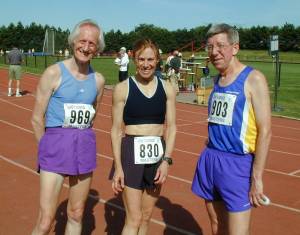
Ed Whitlock, Beverly Coburn, Bob Moore
So she was very right, as nearly a decade later, I’m sticking with the program and see no end in sight. My favourite part is the Maximum Strength Phase as this is where you really see yourself bulk up a little. So why not time this phase to coincide with a reunion with your high school basketball team or a holiday when you will be mainly wearing a swimsuit. The reality of my training is that the maximum weight phase does not coincide with key races. Once the serious racing begins, weight training shifts into maintenance mode and my focus is on becoming very lean and wiry.
Anatomical Adaptation (AA) phase * (2 sets)
Total sessions/Phase
8-12
Sessions/Week
2-3
Load
Select loads that allow only 20-30 reps
Reps/Set
20-30
Speed of Lift
Slow to moderate, emphasizing form
Recovery (in minutes)
1-1.5
* Table from Triathlete’s Training Bible
Here is a list of the weight machines or free weights I use.
UPPER BODY
Lat pull-down machine
Chest press machine
Seated row machine
Free weights or machine for pectoral muscles
Bicep curls with free weights
Reverse wrist curl with free weights
LOWER BODY
Squats on Smith machine
Leg press machine
Calf raise on leg press machine
Knee extension machine (no periodization – 3 x 8-10 reps ongoing maintenance)
Hamstring curl machine (no periodization -3 x 8-10 reps ongoing maintenance)
Hip adductor machine (no periodization – 3 X 8-10 reps ongoing maintenance)
Hip abductor machine (no periodization – 3 x 8-10 reps ongoing maintenance)
For my next weight workout I will enter into the Maximum Transition (MT) phase and then into the Maximum Strength Phase, shortly after. For all the details click on Periodization of Weight Training
Maximum Transition (MT) phase * (3 sets)
Total sessions/Phase
3-5
Sessions/Week
2-3
Load
Select loads that allow only 10-15 reps
Reps/Set
10-15
Speed of Lift
Slow to moderate, emphasizing form
Recovery (in minutes)
1.5-3
* Table from Triathlete’s Training Bible
What happens if you find that you cannot learn to love weight training? If you are a middle-aged woman, you will experience fairly dramatic declines in strength which can result in poor posture and the hunched shoulder look. You might find opening heavy doors progressively more difficult as well as carrying bags of groceries for more than a short while. If you learn to LOVE the results of consistent weight training, you could be bounding up the double set of long stairs, at the York Mills Subway Station, arriving at the top first, while many of the morning commuters are standing or slowly walking up the escalator.
Subway Stations, A Good Place for Circuit Training
A funny thing happens to me while taking public transit. I often get offered a seat by kind, younger men and women, sometimes I happily accept this offer, secretly telling myself that yes, my legs could use a break from all the miles I’ve run.
According to some mental health experts, Monday, January 17thwas the most depressing day of the year. Mainly due to the arrival of bills in the mailbox and gloomy weather. In addition, by this time, many will have abandoned New Years resolutions, short of the 21 days that it supposedly takes for good habits to take hold.
I don’t usually make New Years resolutions as I find that September is the month when I feel most upbeat about tackling new projects. It must be all those years of mom-hood that have me stuck in the school-year cycle. Today however I feel the need to resolve to reduce my sugar intake for the rest of the year.
The reason for this belated resolution is that I have not quite recovered from the holiday season sugar overload and I’m hooked, with the energy lapses and subtle mood swings to show for it. Some have called refined sugar consumption, “Death by installments.” I read and was influenced by the book Sugar Bluesin the late-seventies and this coincided with my return to regular exercise after a five year lapse. The results of these two important lifestyle changes were that my energy level became very consistent and stable through the day. Mid-afternoon sleepiness and drowsiness after meals can be avoided by reducing the refined sugar in our diet, and foods ranking high on the glycemic index.
Here is an enthusiastic review of the Sugar Blues by a more recent reader:
A true health classic! February 3, 2000 Reviewer: A reader from New York City
I’m sugar-free ever since reading “Sugar Blues.” I was sluggish, moody, hungry, etc. I remembered that John Lennonmentioned Dufty’s book in an interview once. So I bought it at the local health food store. He starts off with his own sugar hell and redemption and then delves into the whole history of the cane. Very interesting, health-wise and also politically. . . When I tell people I’m sugar-free they usually scoff, saying sugar’s not that bad for you, why give it up completely. Well, now I wake up clear and I get through the afternoon w/o any flagging of energy. At various times of the day I’ll feel some energy racing through my body. (A great feeling; keeps me motivated.) Now I need less food on my plate, and my hypoglycemia has all but disappeared. (Think about THAT one, folks.) Never eat “refined sucrose” again! It can be done! Sky’s the limit! Thank you, William Dufty!
Sugar Blues by William Duffy
Apparently, John Lennon used to regularly give away copies of Sugar Blues. Well I’m a believer in “baby steps” so here is what I did today to lessen my sugar intake, I had a non-sweet latte, at LIT, foregoing the usual triple-venti-whole-milk-vanilla latte and I skipped a sweet treat. Once I’m back to minimal sugar consumption, a sweet treat can be enjoyed every now and then without ill effect and it will be truly a treat rather than the satisfaction of an unhealthy craving.
I won’t delve into the more serious issues related to blood sugar levels such as Diabetes for which my knowledge is limited to first-year Biology and Nutritional Food Science but one starting point might be this link to The Canadian Diabetes Association.
LIT Latte Art
Here is a great quote from Jack Lalanne, the Godfather of Fitness who passed away recently at the age of 96.
Exercise is King, nutrition is Queen put them together and you have a kingdom.
The wickedly cold Edmonton temperature during our visit last Sunday of -26C has been displaced by +5C. What is going on? And here in Toronto, the capital of not-so-cold-but-damp-cold it is -17C. Wrong place at the wrong time.
Total mileage this week was 50 miles, with four indoor and three outdoor runs. Five or six years ago during a particularly cold January, I ran 31 days with only three outdoor runs. So it could be worse. Thinking of worse I’m reminded of the power failure two winters ago. Funnily enough, our gas furnace was so old (since replaced) that it was able to continue to produce heat and with gas stove and oven, the hardship was not severe. I’m also remembering that a few years ago, I ran the Robbie Burns 8Kin Burlington in a time of 34:58 in -20C temperatures on packed ice and snow. Needless to say, I felt that were conditions better, I might have run faster.
The Communal Mule
We have stayed close to home these past chilly days. Once again, we considered a movie outing and once again, we chose to hunker down on the homestead our only outing, to shop with a coffee break enroute. We tried a new coffee barThe Communal Muleon Dundas west and enjoyed as my husband calls it, “Being tourists in the land of youth.” as inevitably we seem to be the oldest people about in our travels to nouveau espresso bars. I had an excellent shortbread with white chocolate chip cookie and my husband enjoyed his latte.
As for me, I’ve become a bit stuck on Stumptown coffee. Give me Stumptown coffee, Stumptown I say! I’m a believer. There is only one place in Toronto (2 in Canada total) where Stumptown coffee is available, LIT Espresso Bar. We have only been to the College street locations.
Stumptown Coffee at LIT Espresso Bar
Quiet days mean more time to read and I finished The Sea Ladyby Margaret Drabble. The “elegiac” writing and pace of the first 250 pages led to a disappointing finale, complete with a surprise ending, where everything came together, not with elegance but more like a season-ending episode of Desperate Housewives. My very humble opinion for what it is worth, although still recommended as a pretty good read.
The final pages of The Sea Lady contain these words from Scotland’s favourite son, whose birthday is celebrated on January 25th. And — to my husband, I’ll dedicate these lines from Robbie Burns and repeat that NO, the final quote of yesterdays post was in no way related to your plan to watch six hours of football this weekend.
If you have been following my blog, you’ll know that most of the time, I don’t think about running, when I am running. I’ve forwarded the proposition that the more reasons you have to run, and the more that you have to think about while running, the easier it is to stick to running. Does it follow then that since I run A LOT, a lot of what I think about is not about running? Possibly.
Some of those thoughts and activities that occupy me or take place on the run include listening to music and audio books, watching television, list-making, photography, shopping, meal-planning and recently, I’ve become adept at checking my Blackberry while running on a treadmill.
The Pain Gain
However faster running, involving effort, discomfort and pain requires that thoughts be focused on running and it is helpful to develop positive mental strategies to deal with these more challenging physical sensations. At the moment, faster running is about 40 minutes out of the roughly 6-7 hours a week I run. A big part of what motivates me to push past the discomfort and pain is the knowledge of the health benefits of intense running. When you exercise at an intensity over the lactate threshold your body produces Exercise-Induced Growth Hormone Response (EIGR) the effect of which is double the benefit of aerobic exercise.
While running hard, I visually imagine EIGR secretions flowing through my body and soothing my joints. I also think of my heart, pumping vigorously sending blood in strong gushes throughout my circulatory system, massaging and cleansing my arteries. While these images may not be sound biology, you get the picture, it is all about the importance of positive images.
Knee Joint Facsimile
My husband has been having knee trouble for nearly two years. As a joke, I gave him a key chain with a replica of a knee joint. As time passes, I’m thinking that this rattling, fragile looking knee joint may not inspire confidence in recovery and only lends fuel to the argument that the knee joint is poorly designed and engineered. Not the best mindset for visual images of healing and health.
The simple practice described in this quote by Jean Houston strikes me as wise, at the gut level.
“Try to spend a few moments each day holding a picture of your body and your mind in a state of splendid health.”
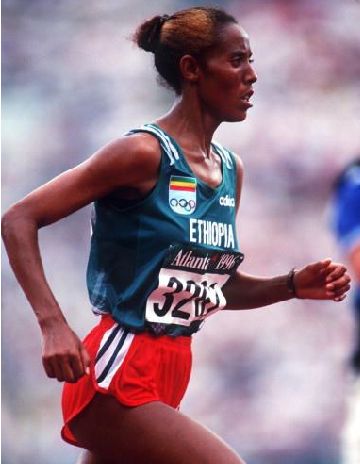
Today I lunched with a friend who is helping my husband and I organize a gala for a sponsorship program for AIDS-HIV orphans in Ethiopia. The program is supported mainly by volunteers, here in Canada is run by People to People Aid Organization, Canada Inc. . Thus I thought it would be timely to profile one of Ethiopia’s finest runners, Fatuma Roba who was the mother of five children when she won the Olympic gold medal.
Born in 1973 and raised in the village of Cokeji in Ethiopia’s mountainous southern region—also home to internationally known 10K champion Derartu Tulu—Roba was one of seven children born to a farming couple who raised and herded cattle. Like most children growing up in rural Africa, if she wanted to go somewhere, the quickest way to get there was to run. The daily run to and from her school—much of it going up and down hills—trained the young Roba in the art of sprinting. As a child her hero was 1960 and 1964 Olympic marathon champion Abebe Bikila, a fellow Ethiopian. After completing school, the five-foot-five-inch Roba decided to train to become a police officer after her performance at a national cross-country championship caught the attention of members of the Adis Ababa prison police athletic team.
Fatuma Roba, Fluid Grace
Roba first gained an international profile in 1990 when at age 18 she placed fourth in the 3,000 meter and 10K competition during the African Championships. Three years later she decided to attempt the 26.2-mile marathon distance in her home town of Addis Ababa, and had reached a personal best time of 2 hours 35 minutes 25 seconds by 1995. Roba continued to reduce her marathon time throughout the spring of 1996, helped along by the coaching of Yilma Berta. To train to excel at the 26.2-mile marathon distance, the 22-year-old Roba logged an average of 125 miles a week, most of it at high altitude, thereby forcing her body to use its resources of oxygen efficiently. She ran and won two marathons early in 1996, the first in January at Marakech and the second in Rome, Italy, two months later.
When Roba joined the field of the 1996 Olympic women’s marathon in Atlanta, Georgia, in July of 1996, she was ranked only 29th among the elite women athletes assembled there. Surprising almost all onlookers of that years’ Summer Games, she managed consistent five-minute miles, gained the lead by mile 13, and left behind Japanese runner Yuko Arimori, who had won the silver at the 1992 Summer Olympics in Barcelona, Spain. At mile 19 timers clocked her race pace at 5:21; relaxed and alert, Roba waved as she passed, the crowds cheering on the first woman in the pack. She went on to cross the line in 2:26:05, her lead a remarkable two minutes. “This is not only a special thing for me but also for my country and all African women,” Roba was quoted as commenting by Amanda Mays in the Philadelphia Inquirer. “The Ethiopian women are coming up in the marathon. This was the breakthrough and now we are ready to challenge the others.”
Roba’s success in Atlanta was balanced by an equally notable performance in 1997 at the 101st Boston Marathon. She gained and held an easy lead by mile 20 to win in 2:26:23. The first African woman ever to win the historic Boston race, Roba bested an elite field that included defending champion Uta Pippig, Japan’s Junko Asari, and South African runners Colleen de Reuck and Elana Meyer. “She ran with the same smooth stride and placid, dispassionate look on her face that she carried through the Olympic race,” reported Runnersworld.com. “Race commentator (and fellow Olympic marathon champion) Frank Shorter called her ‘The most relaxed-looking runner I have ever seen.'” Roba’s performance at the World Championship Marathon held in Athens, Greece, the following fall was a disappointment when she was forced to leave the course after being injured.
One for Ethiopia!
In 1999 the 25-year-old Roba took her third straight win at Boston, her time a personal best of 2:23:25 that set a new women’s overall course record. She won the silver at the Tokyo Marathon with a time of 2:27:05, but at the World Championships in Seville, Spain she finished a disappointing fourth. Roba’s winning streak at Boston ended in 2000, when she fell to third, barely losing the Boston gold to Kenyan runner Catherine Ndereba in one of the closest finishes in Boston Marathon history. Like Seville, the summer heat in Sydney, Australia proved hot enough to stall Roba, who finished a disappointing ninth at September 2000’s Sydney Olympics with a time of 2:27:38.
Like her hero Abebe Bikila, Roba has become a role model for African runners, women runners in particular. Her own younger sister, Sennaito Tekru, has followed in her path, and has embarked on a course as a competitive marathon runner. With her grace and seemingly effortless performances, Roba has broken the barrier for African women with her triumphs at both the Olympic Games and the Boston Marathon. Despite her disappointment in Sydney, she has continued to rank among elite women marathoners, handily winning the San Diego Marathon in 2001 with a time of 2:27:22.
Way back in the mid-eighties, I discovered the benefits of the easy week. I like to think of myself as one of the early adopters of this principle. The hard-easy day principle of training was well ingrained in anyone who had read articles from Runner’s World and Running Times but not so, the easy week.
One reason for experimenting with easy weeks was having spent half of the my first five years of running – injured. Out of necessity those first five years of running were all about trial and error and a lot of research into how the body works.
Fortunately, I was never prone to running through pain so I did not set myself up for chronic injuries. Just as the body carries the memory of hard-training and top fitness, making the road to achieving this easier, once traveled, my sense is that the body also remembers when the warning signal of pain has been ignored and the time for healing replaced by pushing through or masking the pain, a recipe for developing a lifetime chronic running injury.
The easy week, is all about distribution of effort. The hard weeks are more challenging and the easy weeks, well easier. Over the past decade or more, I was running similar weekly mileage to my peers, as an average, but thrown into the mix, would be some blockbuster weeks of say, over 100 miles and weeks with mileage lower than most “serious” marathoners would consider worthy. The concept of the easy week can be expanded to think of easy years. For example, I knew I wanted to be in the best shape of my life when I turned 50. Leading up to this key racing season, I mixed in an easy year just before. I was increasing fitness, however, I was banking all-out race efforts for when I changed age-groups.
Author - Dr. Jim Loehr
Maximizing performance through distribution of effort can be applied to how we manage our lives. I enjoyed The Power of Full Engagement written by Jim Loehr. He says, “Managing ënergy not time is the key to full engagement and optimal performance.” and I think this is relevant to marathon training as well as life management.
In spite of the faulty analogy Loehr uses to describe his insights, unflattering comparisons of marathoners with sprinters, the basics of what he says rings true for me. As for the analogy, Loehr is a tennis player and his sprinter versus marathoner metaphor demonstrates that he is unfamiliar with the training methods of high-performance distance runners who in fact, must draw on several energy systems to perform optimally.
In running and in life, knowing when is the best time to do what, and the energy demands or complexity of those tasks is a step towards improving RESULTS.
High on Denali, with Peaks of Mt. Hunter (I think) in Sight
Some deal with extreme weather better than others. Here is a photo of my nephew while on a spectacular snowy adventure, climbing Denali, the highest mountain in North America. As mentioned a couple of days ago, I did not fully appreciate the enormity of the feat until seeing a documentary on the topic. Kudos!
My son suggested that his cousin did not want to “crush my dreams” when I made my naive inquiries about trying this myself to which he politely replied, “It is a very technical climb”.
As for two Toronto runners, visiting Edmonton during a time which has the locals saying they can’t remember having this much snow, we escaped the chill with a third trip to Servus Place to run indoors. The drive there bore some similarities to a bobsled event, as we made our way through snow-packed, icy roads that seemed more like snowy channels with snow piled high, all round and well past car height.
I choose to run on the 250 meter indoor track rather than the treadmill. I had run on this track once before, a couple of summers back, barefoot. The track was deserted, making it easy to give barefoot running a try. Today, I realized upon setting foot on the track, that while too busy to run barefoot, it was to be a far better indoor running experience than the treadmill.
The track is larger, by 50 meters, than any of the indoor tracks in Toronto such as York University and the University of Toronto. Running around the fourth, outside lane. six laps will get you just over a mile at Servus Place. Apart from the Louis Riel indoor track in Ottawa, this is as good as it gets for indoor tracks.
Legs come alive on Servus Place 250 meter track.
And thanks to the synergy of all the runners and walkers about, I did my six miles at a brisker than-planned-for pace. Fun!
For the third day, I stopped byBooster Juice for my post-run treat. Today I ordered my favourite smoothie, the Canadian Colada, a blend of pineapple, coconut, bananas, peaches and vanilla frozen yogurt.
All said and done, I agree with Rachel Carson who said, “Those who dwell among the beauties and mysteries of the earth are never alone or weary of life.” to which my mountaineering nephew can attest, I’m sure. However I’ll add that the marvels of an outstanding indoor recreational facility in -26C weather has inspired this snow-weary runner to think of Servus Place, as the 8th man-made wonder of the world.
This week has been busy, beginning with an early morning trip to Kitchener-Waterloo to pick up our ailing son at the Grand River Hospital Emergency room. He was suffering from a severe flu-like, sore throat infection which was not strep throat. So he has been home to recuperate. Our roommate Alain has returned to school in an IT program and we enjoyed hearing about his first week of classes.
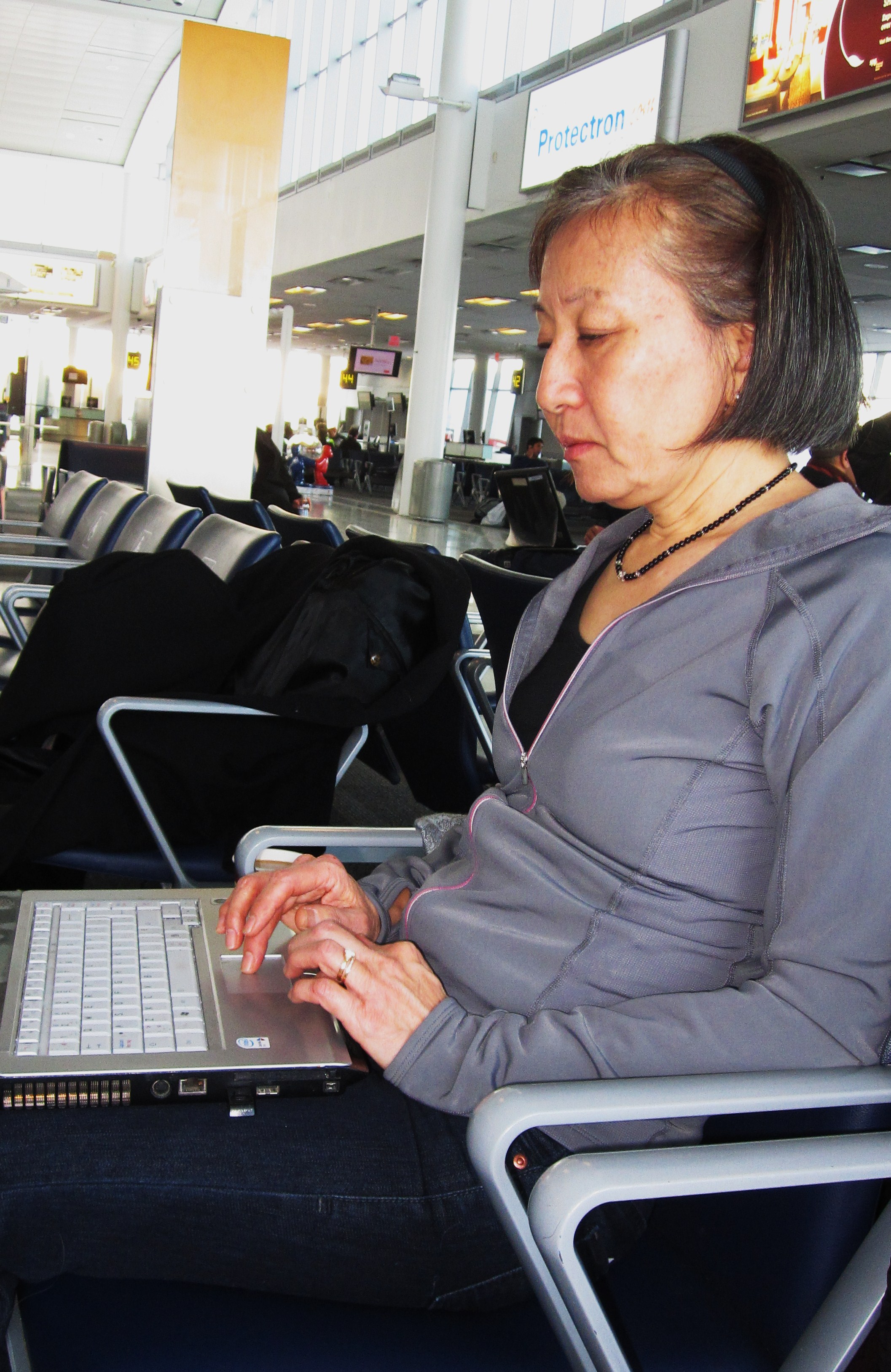
Blogging at Pearson Airport in My MEC Thermal Hoodie
And my husband and I arrived at Pearson Airport around 8 a.m. today, heading to Edmonton to visit his 95 year old father who is able to live independently. Current temperatures in Edmonton are -23C so most of my running will be done indoors. Happily, there is a absolutely fabulous recreation centre close by, the Servus Centrewhich resembles an indoor village with hockey rinks, basketball courts, pool with fabulous waterplay areas, a large indoor track and treadmills a-plenty. I’ve never seen anything like it.
The treadmills have a built-in fan, a unique feature in my treadmilling experience. Although they do not have the downhill option, that I once enjoyed at the downtown YMCA in Ottawa. That would be helpful for those training for the Boston marathon.
After a Servus Centre work-out, we enjoy a post-workout treat, at the Booster Juice located in the grand foyer. My favourite is the Canadian Colada.
In spite of our 7:30 a.m. departure, I did run this morning, 25 minutes on the treadmill, to loosen up before getting chained to a seat for a few hours. Torontonians rejoice, -11C, you have nothing to fear.
















 Mind, Motion & Matter