
Today I lunched with a friend who is helping my husband and I organize a gala for a sponsorship program for AIDS-HIV orphans in Ethiopia. The program is supported mainly by volunteers, here in Canada is run by People to People Aid Organization, Canada Inc. . Thus I thought it would be timely to profile one of Ethiopia’s finest runners, Fatuma Roba who was the mother of five children when she won the Olympic gold medal.
FATUMA ROBA Biography (click here for link to website where I found this article)
Born in 1973 and raised in the village of Cokeji in Ethiopia’s mountainous southern region—also home to internationally known 10K champion Derartu Tulu—Roba was one of seven children born to a farming couple who raised and herded cattle. Like most children growing up in rural Africa, if she wanted to go somewhere, the quickest way to get there was to run. The daily run to and from her school—much of it going up and down hills—trained the young Roba in the art of sprinting. As a child her hero was 1960 and 1964 Olympic marathon champion Abebe Bikila, a fellow Ethiopian. After completing school, the five-foot-five-inch Roba decided to train to become a police officer after her performance at a national cross-country championship caught the attention of members of the Adis Ababa prison police athletic team.
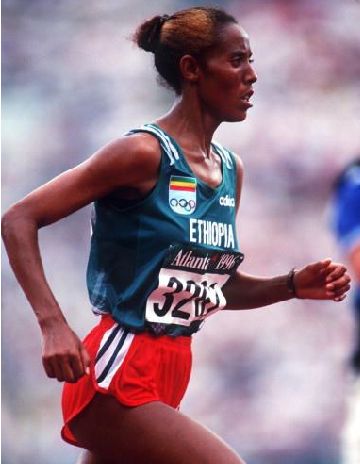
Fatuma Roba, Fluid Grace
Roba first gained an international profile in 1990 when at age 18 she placed fourth in the 3,000 meter and 10K competition during the African Championships. Three years later she decided to attempt the 26.2-mile marathon distance in her home town of Addis Ababa, and had reached a personal best time of 2 hours 35 minutes 25 seconds by 1995. Roba continued to reduce her marathon time throughout the spring of 1996, helped along by the coaching of Yilma Berta. To train to excel at the 26.2-mile marathon distance, the 22-year-old Roba logged an average of 125 miles a week, most of it at high altitude, thereby forcing her body to use its resources of oxygen efficiently. She ran and won two marathons early in 1996, the first in January at Marakech and the second in Rome, Italy, two months later.
When Roba joined the field of the 1996 Olympic women’s marathon in Atlanta, Georgia, in July of 1996, she was ranked only 29th among the elite women athletes assembled there. Surprising almost all onlookers of that years’ Summer Games, she managed consistent five-minute miles, gained the lead by mile 13, and left behind Japanese runner Yuko Arimori, who had won the silver at the 1992 Summer Olympics in Barcelona, Spain. At mile 19 timers clocked her race pace at 5:21; relaxed and alert, Roba waved as she passed, the crowds cheering on the first woman in the pack. She went on to cross the line in 2:26:05, her lead a remarkable two minutes. “This is not only a special thing for me but also for my country and all African women,” Roba was quoted as commenting by Amanda Mays in the Philadelphia Inquirer. “The Ethiopian women are coming up in the marathon. This was the breakthrough and now we are ready to challenge the others.”
Roba’s success in Atlanta was balanced by an equally notable performance in 1997 at the 101st Boston Marathon. She gained and held an easy lead by mile 20 to win in 2:26:23. The first African woman ever to win the historic Boston race, Roba bested an elite field that included defending champion Uta Pippig, Japan’s Junko Asari, and South African runners Colleen de Reuck and Elana Meyer. “She ran with the same smooth stride and placid, dispassionate look on her face that she carried through the Olympic race,” reported Runnersworld.com. “Race commentator (and fellow Olympic marathon champion) Frank Shorter called her ‘The most relaxed-looking runner I have ever seen.'” Roba’s performance at the World Championship Marathon held in Athens, Greece, the following fall was a disappointment when she was forced to leave the course after being injured.

One for Ethiopia!
In 1999 the 25-year-old Roba took her third straight win at Boston, her time a personal best of 2:23:25 that set a new women’s overall course record. She won the silver at the Tokyo Marathon with a time of 2:27:05, but at the World Championships in Seville, Spain she finished a disappointing fourth. Roba’s winning streak at Boston ended in 2000, when she fell to third, barely losing the Boston gold to Kenyan runner Catherine Ndereba in one of the closest finishes in Boston Marathon history. Like Seville, the summer heat in Sydney, Australia proved hot enough to stall Roba, who finished a disappointing ninth at September 2000’s Sydney Olympics with a time of 2:27:38.
Like her hero Abebe Bikila, Roba has become a role model for African runners, women runners in particular. Her own younger sister, Sennaito Tekru, has followed in her path, and has embarked on a course as a competitive marathon runner. With her grace and seemingly effortless performances, Roba has broken the barrier for African women with her triumphs at both the Olympic Games and the Boston Marathon. Despite her disappointment in Sydney, she has continued to rank among elite women marathoners, handily winning the San Diego Marathon in 2001 with a time of 2:27:22.




 Mind, Motion & Matter